
As always, I want to thank all of the readers who have sent messages of support and financial assistance. Please visit my Go Fund Me if you’d like to help me keep this column going.

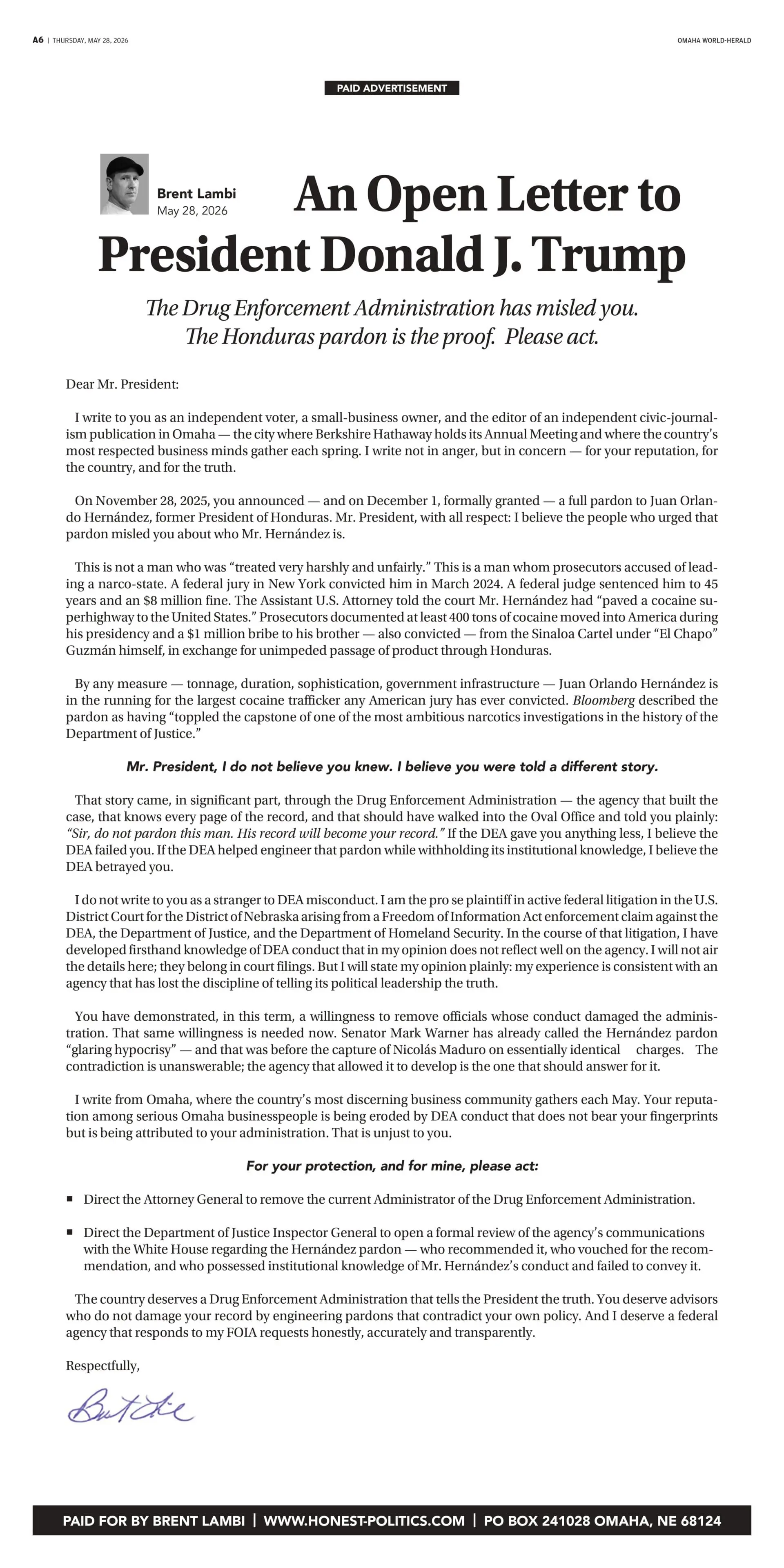
An Open Letter to President Donald J. Trump: The Drug Enforcement Administration has misled you. The Honduras pardon is the proof. Please act.

by | May 28, 2026 | Political

Explore More from Brent Lambi

Who Gets to Decide If You’re Heard? Actually, the Federal Government

Who Gets to Decide If You’re Heard? Actually, the Federal Government

Who Gets to Decide If You’re Heard?
Actually, the Federal Government
Honest
Politics
By Brent Lambi
The mailbox and the inbox were never neutral plumbing. They are levers and
the most dangerous kind of silence is the kind you never even notice.
OPINION | June 3, 2026
We live by two quiet beliefs: that the letter we mail will arrive, and the email we send will land completely unfiltered without interference. We stake our friendships, our businesses, even our court cases on them. Yet both pass through hands we never see, and those hands hold more power than we dare imagine or realize.
Email is NOT a sealed letter passed hand to hand. It is an electronic postcard relayed through sorting machines. First your provider, then theirs, and strangers in between. At each stop software decides whether your words move on, get buried, or vanish. You meet this power daily in the spam folder: a filter you never set, choosing what you will never see. Now add the government’s reach. A 1994 law requires phone carriers to build their networks so the state can intercept communications on lawful order; regulators stretched that mandate to broadband internet in 2005.1 Providers can be forced to surrender your messages, log who you talk to, throttle your connection, or make a website refuse to load.2 The internet is not free air. It runs through a few licensed companies that answer to Washington.
Your paper mail via the United States Postal Service is no safer. Since the 2001 anthrax killings, postal machines have photographed the outside of nearly every piece of mail in the country that generate billions of images a year.3 A century-old tool called a “mail cover” lets investigators record the outside of your letters before delivery, mapping everyone you write to.4 Opening a sealed envelope still takes a warrant; learning your every contact does not.5 And a single form can quietly hold or reroute everything in your box.
Here is the heart of the danger, and it should chill you: these powers are nearly invisible. A letter that never arrives looks exactly like one never sent. A buried email looks exactly like a message no one answered. The donation that never landed, the reply that never reached you. Each wears the mask of ordinary bad luck. You cannot mourn the letter you were never handed. The deepest power is not the power to shout you down in public; it is the power to decide, in silence, which of your words ever finish their journey and all the while you suspect nothing.
Dissent is strangled in a free country not with a midnight knock, but with a thousand quiet failures no one can prove.
This is not paranoia; it is documented history. For fifteen years the FBI’s secret COINTELPRO program spied on, smeared, and tried to destroy civil-rights leaders, antiwar activists, and ordinary dissenters.6 A president kept an “enemies list” and turned federal agencies loose on the names.7 None of it was confessed. It took a break-in and the Church Committee hearings to expose it,8 and the warrant rules we rely on today exist only because these powers were already abused once.9
And it is not only history. Beginning in 2025, the government invoked a 1798 wartime law to deport people it branded members of a foreign “terrorist” group with sharply limited opportunities for hearings and judicial review. 10 When a judge ordered the flights stopped, the planes landed in a foreign prison anyway, and the court found probable cause for criminal contempt. 11 The Supreme Court later ruled the people swept up had been denied due process, given barely a day to show the government had the wrong man. 12 The official Trump defense: that judges had no right to second-guess a “national security” call.
Sit with that, for it is the whole nightmare in a single line. Once Trump officials brand you a “threat,” they claim the right to act first and answer to a court later, if ever. Now picture that machinery aimed at a critic, a donor, a journalist, or a political rival by a government willing to ignore the courts and warrant requirements and invent the label. Your funding withers as contributions silently fail to arrive. Your website slows to nothing. Your mail disappears. An investigation opens on a charge built from a lie; your accounts freeze, your name is ruined. And because each blow looks like coincidence, you may never learn it was done to you on purpose.
This is why proof still matters. A sheriff or process server who places a document in your hand face to face, and a filing stamped into a court’s permanent record, create what no filter can erase or prevent: a witness, a date, a record that survives.
And remember: all of this was once done by hand, by clerks with paper files, which limited how far it could reach. Artificial intelligence erases that limit. A machine can now read, sort, slow, and bury millions of messages at once, learning whose voice to silence faster than any watchdog can follow. The tool that filters junk from your inbox can, in the wrong hands, filter out dissent.
So what must a free people demand? Plain rules on when our communications may be touched, and by whom. Audits that outlive any administration. Honest answers when a citizen asks what the government holds. Courts and watchdogs with teeth. Court orders that are obeyed rather than are blatantly ignored by the Trump Administration. None of this is radical; it is the difference between a government we can check and one we must simply trust.
The mailbox and the inbox were never neutral plumbing. They are levers, and whoever works them decides who is heard and who is quietly switched off. The most dangerous power is not the power to silence you with a shout. It is the power to silence you so smoothly that you never even know it happened.
NOTES & SOURCES
1 Lawful-intercept mandate. The Communications Assistance for Law Enforcement Act (CALEA), Pub. L. 103-414, enacted in 1994, requires telecommunications carriers to design their networks so that, with a court order or other lawful authorization, the government can intercept communications and obtain call-identifying information. Originally it covered telephone and similar services; in 2005 the Federal Communications Commission extended its reach to facilities-based broadband internet access and interconnected internet phone service. See 47 U.S.C. §§ 1001–1010; FCC, fcc.gov/calea.
2 Compelled disclosure and network control. Under the Electronic Communications Privacy Act and its Stored Communications Act (1986), providers can be compelled by warrant, court order, or subpoena to turn over the contents of communications and records of whom a customer contacts. Because internet access is delivered by regulated private carriers, the same systems that manage network traffic can be used to slow, prioritize, or block particular destinations.
See 18 U.S.C. §§ 2701–2712.
3 Mail imaging. Through the Mail Isolation Control and Tracking program, Postal Service equipment photographs the exterior of essentially every piece of mail processed in the United States — roughly 160 billion items in the year before the program became public. Created after the 2001 anthrax killings, it surfaced in 2013 when the FBI cited it in a ricin-letter investigation. See Ron Nixon, “U.S. Postal Service Logging All Mail for Law Enforcement,” The New York Times, July 3, 2013.
4 Mail covers. A “mail cover” is a long-used investigative tool in which postal employees record the information on the outside of a target’s mail and forward it to the requesting agency; the sealed contents are not opened. Tens of thousands of pieces of mail are subject to this each year, and a 2014 audit by the USPS Office of Inspector General found that the Postal Service approved the large majority of such requests, sometimes with weak controls. See USPS OIG audit (2014), as reported by The New York Times.
5 Warrant protection for sealed mail. In Ex parte Jackson, 96 U.S. 727 (1878), the Supreme Court held that sealed letters and packages in the mail are protected by the Fourth Amendment and may not be opened without a warrant — a protection that does not extend to the information written on the outside of the envelope.
6 COINTELPRO. The FBI’s Counterintelligence Program (c. 1956–1971) secretly surveilled, infiltrated, and sought to discredit civil rights organizations, antiwar groups, and political dissidents, including Dr. Martin Luther King Jr. Its existence reached the public after activists removed files from an FBI office in Media, Pennsylvania, in 1971. Documented in the Church Committee Final Report, S. Rep. No. 94-755 (1976).
7 The “enemies list.” The Nixon administration maintained a list of political opponents — made public during the 1973 Senate Watergate hearings — whom it sought to target through tax audits and other federal levers. See testimony and exhibits, Senate Watergate Committee (1973).
8 The Church Committee. The U.S. Senate Select Committee to Study Governmental Operations with Respect to Intelligence Activities, chaired by Senator Frank Church, investigated decades of intelligence abuses and issued its final reports in 1976. See S. Rep. No. 94-755 (1976).
9 Reform born of abuse. In direct response to the abuses the Church Committee exposed, Congress passed the Foreign Intelligence Surveillance Act of 1978, Pub. L. 95-511, creating warrant procedures and a specialized court for national-security surveillance. See 50 U.S.C. § 1801 et seq.
10 Wartime law, no hearings. Beginning in March 2025, the Trump administration invoked the Alien Enemies Act of 1798 — a wartime statute previously used for World War II–era internment — to rapidly deport Venezuelan nationals it accused of belonging to Tren de Aragua, which it had designated a foreign terrorist organization. Its legal position was that it could carry out these removals without the hearings or judicial review ordinarily required; in court filings the government conceded that many of those removed had no U.S. criminal records. See NPR, “Trump asks Supreme Court to allow deportations under Alien Enemies Act,” March 28, 2025.
11 Contempt. After Chief Judge James Boasberg of the U.S. District Court for the District of Columbia issued a temporary restraining order halting the deportation flights, the planes nonetheless arrived in El Salvador. On April 16, 2025, the judge found probable cause to hold the government in criminal contempt for violating the order; the Justice Department argued he had overstepped into matters of foreign policy. See NPR, April 16, 2025.
12 Due process denied. In a per curiam decision on May 16, 2025 (7–2), the U.S. Supreme Court found that roughly 24 hours’ notice before removal, lacking information on how to exercise due-process rights, did not pass constitutional muster, and barred further removals of the named plaintiffs pending review. A federal judge separately ruled in December 2025 that the men deported in March had been denied due process. See Courthouse News Service, May 16, 2025; NPR, Dec. 22, 2025.
Scan the code to visit
HONEST-POLITICS.COM

read more
MAGA’s Worldwide Finance Plan Paid in Cocaine Poison: A convicted cocaine kingpin walks free — and the timing tells you everything.

MAGA’s Worldwide Finance Plan Paid in Cocaine Poison: A convicted cocaine kingpin walks free — and the timing tells you everything.

MAGA’s Worldwide Finance Plan Paid in Cocaine Poison
OPINION | May 31, 2026
THERE IS A WORD, for a government that frees a convicted drug trafficker and presses him into the service of its foreign policy. The word is not “conservative.” It is not “populist.” It is not even “corrupt,” though corruption is the least of it. The word is captured — and on December 1, 2025, the United States gave its clearest demonstration yet of what critics argue is a movement that no longer recognizes the difference between a statesman and a smuggler.
On that day, the President of the United States signed a full pardon for Juan Orlando Hernández. Eighteenmonths earlier, a jury of Americans had convicted him — not of jaywalking, but of conspiring to move more than 400 tons of cocaine into this country. The trial judge found that Hernández turned his country’s army and police into protection networks linked to the Sinaloa Cartel. “El Chapo” Guzmán himself, prosecutors alleged, funneled roughly a million dollars through Hernández’s associates. The sentence was forty-five years. He served barely one before Donald Trump set him free.
Ask the only question that matters: why?
Consider first what was set loose. Four hundred tons of cocaine is roughly 882,000 pounds — some 400 million grams. At a wholesale price near $28,000 a kilogram, that single conspiracy was worth more than$11 billion before a gram was ever cut; sold off by the gram on American streets at $100 to $150 apiece, the same load is worth $40 to $60 billion. The Justice Department called it “billions of individual doses” —roughly 4.5 billion of them — fed into a country where, in 2023 alone, nearly 30,000 Americans died in overdoses involving cocaine. There is no honest formula that turns tonnage into a body count, but hold those numbers beside each other: billions of doses on one side, tens of thousands of graves a year on the other. That is the record associated with the man Donald Trump set free.
Not for mercy — critics argue this movement has shown little mercy to the desperate. The same administration that freed the kingpin has authorized aggressive anti-narcotics operations in the
Caribbean and Pacific that critics argue have at times used overwhelming force against suspected smuggling vessels. Deaths have been reported in connection with those operations, raising serious questions among critics about proportionality, due process, and rules of engagement. A man who shipped 400 tons of cocaine gets a pardon and a TikTok thank-you note; a fisherman with an empty hold gets a missile.
LOOK AT THE TIMING,because the timing is a confession. The pardon was issued three days before Honduras went to the polls — while Hernández’s political allies were attempting to retain power. Critics immediately argued that the timing created the appearance of ideological
Honest
Politics
By Brent Lambi
favoritism. Critics argued that the decision looked less like ordinary clemency and more like an overtly ideological intervention into a politically sensitive regional moment.
And it was not the work of one country. In Argentina, this administration dangled forty billion dollars before President Javier Milei — and Trump stood in the Oval Office and publicly emphasized the political importance of Milei’s continued electoral success while discussing the financial support. In Brazil, it sanctioned the very judge who prosecuted Jair Bolsonaro for attempting a coup. In Colombia, it has threatened President Gustavo Petro with military force. And when it staged its “Shield of the Americas” summit, it pointedly excluded the elected presidents of Brazil, Mexico, and Colombia — the three largest democracies in Latin America — while seating its ideological clients in the front row.
String those beads together and a pattern begins to appear. A pardon here, a bailout there, a sanction, a threat, a snub — each one defensible in isolation, each one damning in sequence. Critics increasingly argue that this is not merely foreign policy, but the construction of an openly ideological sphere of influence across the hemisphere.
So here is the question Congress is duty-bound to ask and too cowardly to ask aloud:
Why was the pardon power of the United States used to restore to freedom a man federal prosecutors once described as a central figure in one of the largest cocaine-trafficking conspiracies ever prosecuted in the Americas?
Where is Hernández now? Whom does he meet? Which of the networks laid bare in open court remain operational? These are not the fevered questions of a conspiracy theorist. They are the obvious questions of any prosecutor who has read the transcript — and any senator who swore an oath to the Constitution rather than to a man. MAGA will call this hysteria. Let them. There is nothing hysterical about reading a verdict, a pardon, and a calendar and noticing they line up. The hysteria belongs to a political culture critics argue increasingly applies the law unevenly depending on who benefits politically.
The United States once prosecuted this man. Now it has chosen to restore him to freedom. If Congress cannot summon the spine to ask why — under oath, in public, with subpoenas — then the capture is complete, and the only thing separating the government from the cartel is the letterhead.
Ask the question. The country is owed an answer.
SOURCES & METHOD
Conviction, sentence & bribe: U.S. Attorney’s Office, S.D.N.Y., and U.S. Dept. of Justice, “Juan Orlando Hernández … Sentenced to 45 Years … for Conspiring to Distribute More Than 400 Tons of Cocaine, “June 26, 2024 (incl. ≈ $1M paid via his brother by Joaquín “El Chapo” Guzmán). Pardon issued Dec. 1,2025 (Congressional Research Service, IN12621; FactCheck.org, Dec. 5, 2025).
Conversion & wholesale value: 400 metric tons = 400,000 kg = 881,849 lb = 14,109,585 oz =400,000,000 g. At a U.S. wholesale price of ≈ $28,000/kg — about $12,700/lb — (UN Office on
A PERSONAL NOTE
FROM THE AUTHOR
THEY HAVEN’T THROWN ME FROM A WINDOW — BUT THEY ARE TRYING
In Putin’s Russia, dissidents have a way of falling from hospital windows. Businessmen who speak inconvenient truths meet inconvenient ends on staircases and balconies across Moscow. I am writing this from Omaha,
Nebraska. I have not been thrown from a window.
THE IRS AS A WEAPON OF SILENCE
But I am being thrown out of something just as vital: my life savings. What I am experiencing is what I believe to be a targeted, methodical IRS assault — not random, not routine, not coincidental. It follows my speaking out. It follows my refusal to be silenced. In Russia, they silence critics with gravity. In America, I think they are learning to do it with audits, paperwork, and financial ruin — stripping away everything a person has built until the cost of their voice becomes too steep to bear.
See Lambi v. United States of America, et al
Case # 8:2026cv00101
U.S. District Court for the District of Nebraska
SLANDER THROUGH TRUSTED
INSTITUTIONS: THE BERKSHIRE
HATHAWAY CAMPAIGN
And the IRS is not the only instrument being wielded against me. I believe I have also been the victim of deliberate, government-sourced slander — lies spread to professional contacts who had no reason to doubt what they were told. I believe that honest, hardworking realtors employed by Berkshire Hathaway — one of the most respected real estate companies in America built on a foundation of integrity — were fed false information about me by government actors. These were decent professionals simply doing their jobs, used as unwitting vectors of what I think is a smear campaign designed to isolate me professionally, damage my reputation, and ensure that doors would close before I could even knock on them. This is not the free market. This is not the rule of law. This is the deliberate destruction of a private citizen’s livelihood by government machinery set in motion to punish dissent. I believe that Berkshire Hathaway is as much of a victim in this as I am.
See Brent Lambi, Pro Se V. Berkshire Hathaway Home Services, et al
Case # DO1CI260001752
Nebraska District Court, Douglas County
I AM STILL STANDING
This is the American version of defenestration. No broken glass. No headlines. Just a man — his savings under assault, his name poisoned in his own community — meant to serve as a quiet warning to everyone watching. The message is clear: speak up, and we will take everything. Your money. Your reputation.
Your future.
I am still watching. I am still writing. I am still standing. And I intend to be heard.
The opinions expressed above are solely those of the author.
PAID FOR BY BRENT LAMBI PO BOX 241028 OMAHA, NE 68124
WWW.HONEST-POLITICS.COM
BY THE NUMBERS
A convicted cocaine kingpin walks free — and the timing tells you everything.
Drugs& Crime), 400,000 × $28,000 = $11.2 billion.
Retail value: at a U.S. street price of $100–$150/g — about $2,835–$4,250 per ounce — (UNODC; DEA; Office of National Drug Control Policy), 400,000,000 g × $100–150 = $40–$60 billion. Wholesale and retail are alternative valuations of the same load, not additive.
Doses: DOJ characterized the load as “billions of individual doses”; ≈ 4.5 billion estimate, Al Jazeera, Dec. 2, 2025 (≈ 0.09 g per dose).
Overdose deaths: 29,449 U.S. cocaine-involved overdose deaths in 2023 — ≈ 28% of all overdose deaths (CDC WONDER; National Institute on Drug Abuse, 2025). No figure here estimates deaths caused by this specific shipment; tonnage cannot be converted to a death toll.
Maritime strikes: cumulative reported death toll from U.S. strikes on alleged drug vessels in the Caribbean and Eastern Pacific, late 2025 (press reporting; administration statements).
Argentina: U.S. Treasury $20 billion currency-swap line plus a $20 billion private financing facility, October 2025 (U.S. Dept. of the Treasury; Financial Times). Brazil judicial sanctions, Colombia threats, and “Shield of the Americas” exclusions per contemporaneous press reporting.

read more
We’re Both Getting Dirty: Berkshire Hathaway HomeServices and I are both being financially bled by the same thing — and it isn’t each other. The pig in Charlie Munger’s parable is wearing a federal badge.

We’re Both Getting Dirty: Berkshire Hathaway HomeServices and I are both being financially bled by the same thing — and it isn’t each other. The pig in Charlie Munger’s parable is wearing a federal badge.

PAID ADVERTISEMENT
Berkshire Hathaway HomeServices and I are both being
financially bled by the same thing — and it isn’t each other.
The pig in Charlie Munger’s parable is wearing a federal badge.
We’re Both Getting Dirty
Honest
Politics
By Brent Lambi
OPINION | May 24, 2026
Charlie Munger said it plain. “Never wrestle with a pig. You both get dirty, and the pig likes it.” I want to say something today that an opposing party in active litigation almost never says. Berkshire Hathaway and I are both being hurt. By the same thing. And it isn’t each other.
Let me state my interest plainly. I am the pro se plaintiff in Case No. CI 26-1752, Douglas County District Court. I sued Berkshire Hathaway HomeServices entities for breach of a Buyer’s Listing Agreement and defamation. Separately, I have a federal civil rights and FOIA enforcement case pending in the U.S. District Court for the District of Nebraska, Case No. 8:26-cv-00101-SMB-RCC, against components of the DEA, DOJ, and DHS.
Those two cases should have nothing to do with each other. They do.
Here is what I believe, in plain English. A federal officer, acting outside the lawful boundaries of their office, has reasons to want my state defamation case bogged down. Discovery in my state case touches my federal case. If my state case never produces discovery, their exposure shrinks. Delay protects them. Resolution exposes them.
That is the pig in the pen.
Now here is what most writers would never admit. Berkshire is not the villain in this story. Berkshire is bleeding too.
Count the costs. Defense counsel fees, billed by the hour, in a case the math says should have settled. Insurance reserves tied up. Brand exposure every week the case stays in the news. Discovery motions, depositions, sanctions briefing — none of that comes cheap. Every dollar Berkshire’s insurer spends defending this case past the point where settlement made sense is a dollar shareholders will not see. Charlie Munger could have done that arithmetic on a napkin.
And me? I am a pro se plaintiff carrying my own load on two fronts at once. Filing fees, transcripts, expert costs, the unrecoverable hours of my own life. Reputation hits in a small civic-journalism market. Stress I will not pretend does not exist.
Both sides of the “v.” are losing money. The only party making a return on this litigation is the federal actor who benefits from delay.
Which raises the only question that matters: why is this case still being fought the way it is being fought?
I do not believe Berkshire Hathaway HomeServices, as a sophisticated business defendant, would choose to fight a routine state defamation and breach-of-contract case this way.
The conduct does not match the math. Defenses calibrated for delay, not resolution. Discovery resistance that costs more than the underlying claim. A posture that drives up fees on both sides while the actual exposure sits unchanged.
When the math does not work, somebody else is doing the calculations.
I believe — and I will say it directly — that the defense strategy in this case is being shaped, influenced, or coordinated by interests outside the four corners of the Berkshire Hathaway HomeServices contractual relationship. A third party. One with its own reasons. One whose interests are not Berkshire’s interests, and are certainly not mine.
If that is true, Berkshire is not the defendant. Berkshire is the host. And I am the bait.
Charlie Munger warned about exactly this. When you wrestle with a pig, the pig sets the rules. The pig picks the venue. The pig decides how long the fight goes. And when it is over, the pig walks away clean while everyone else is covered in mud and short on cash.
So I will say what a writer and a plaintiff can say at the same time. Berkshire, look at the bill. Look at who benefits. Look at who keeps pushing for more depositions, more delay, more motion practice in a case that should have closed months ago. Whose money is paying for this? Whose strategy is this actually serving?
And then look at the door. I am open to resolution. I have always been open to resolution. A buyer’s agency dispute is not a constitutional crisis. It is a contract and a duty of care, and grown adults find a number. If Berkshire’s actual decision-makers want to talk — not the defense apparatus, the actual decision-makers — the door is open.
What I am not willing to do is keep wrestling indefinitely while a federal officer profits from our fight.
That is the story. A pig in the pen. Two parties getting bled. One actor laughing.
Charlie Munger told us how this ends. We both get dirty. The pig likes it. The question for Omaha, for Berkshire shareholders, and for every lawyer billing on this case, is whether anyone is going to do the obvious thing: stop wrestling each other, and look at who let the pig in.
The author is the pro se plaintiff in Case No. CI 26-1752, Douglas County District Court, and in the matter docketed as Case No. 8:26-cv-00101-SMB-RCC, U.S. District Court for the District of Nebraska. The opinions expressed are the author’s own and reflect allegations and beliefs based on the public record and the author’s observation of the proceedings. Nothing herein is intended as a finding of fact against any party. All parties named are presumed entitled to a full and fair adjudication on the merits. Honest Politics welcomes responses for publication.

read more