
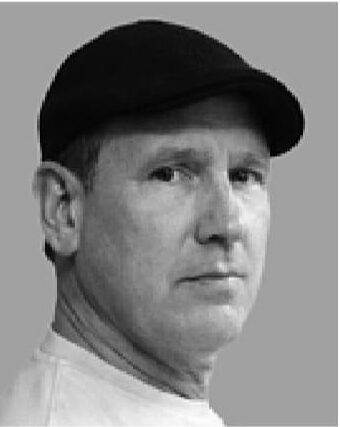
About Brent Lambi
Brent Lambi is an Omaha-based real estate investor and developer whose career spans more than four decades of business leadership, civic engagement, and community development. A native of the greater Omaha area, Lambi has built a distinguished record of transforming ideas into lasting institutions.
Lambi earned a Bachelor of Arts in Accounting from the University of Northern Iowa in 1982, followed by a Juris Doctor from Creighton University School of Law in 1985. That combination of financial acumen and legal training has informed every dimension of his professional and civic life.
His business career took root through a professional relationship he cultivated at Coopers & Lybrand, the international accounting and consulting firm, while working with an Omaha-based company. That early foundation sharpened his instincts for finance, operations, and strategic growth — and set the stage for decades of entrepreneurial and civic achievement. He also became a pivotal figure in the revitalization of Omaha’s historic Old Market district, spearheading Tax Increment Financing development projects that helped restore and energize one of the city’s most beloved neighborhoods.
Over the years, Lambi built a record of real estate development and investment across the Midwest and beyond, contributing to residential and commercial projects in Nebraska, Missouri, Kansas, Iowa, and Texas. In more recent years, he has focused his investment activity on a carefully selected portfolio of publicly traded companies, applying the same disciplined, long-term thinking that defined his earlier career.
Lambi is also a committed philanthropist whose charitable giving reflects a deep sense of civic responsibility. His support has included Volunteer Fire Departments and First Responder organizations in Iowa, as well as contributions to the ACLU, the American Red Cross, Save Inc., and other charitable causes. He is also currently working with the Rockefeller Neurological Institute at West Virginia University in support of research focused on Parkinson’s Disease, Alzheimer’s Disease, and addiction.
Beyond business, Lambi is a recognized civic voice and prolific editorial writer, contributing opinion pieces on fiscal policy, democratic governance, constitutional accountability, and the health of American institutions. A lifelong Independent voter with a history of supporting candidates from both parties, he brings a perspective rooted in the rule of law, fiscal responsibility, and the enduring promise of the American middle class.
Brent Lambi remains deeply connected to Omaha and its future, continuing to invest in the community he has called home throughout his career.
A Voice for Independent Thought
Honest Politics is dedicated to thoughtful editorial commentary grounded in principle, accountability, and a belief in the strength of American democracy. Brent Lambi writes to inform readers, challenge assumptions, and encourage civic engagement through honest political discussion.
Help Keep Honest Politics Going
As always, I want to thank all of the readers who have sent messages of support and financial assistance. Please visit my Go Fund Me if you’d like to help me keep this column going.
Recent Articles
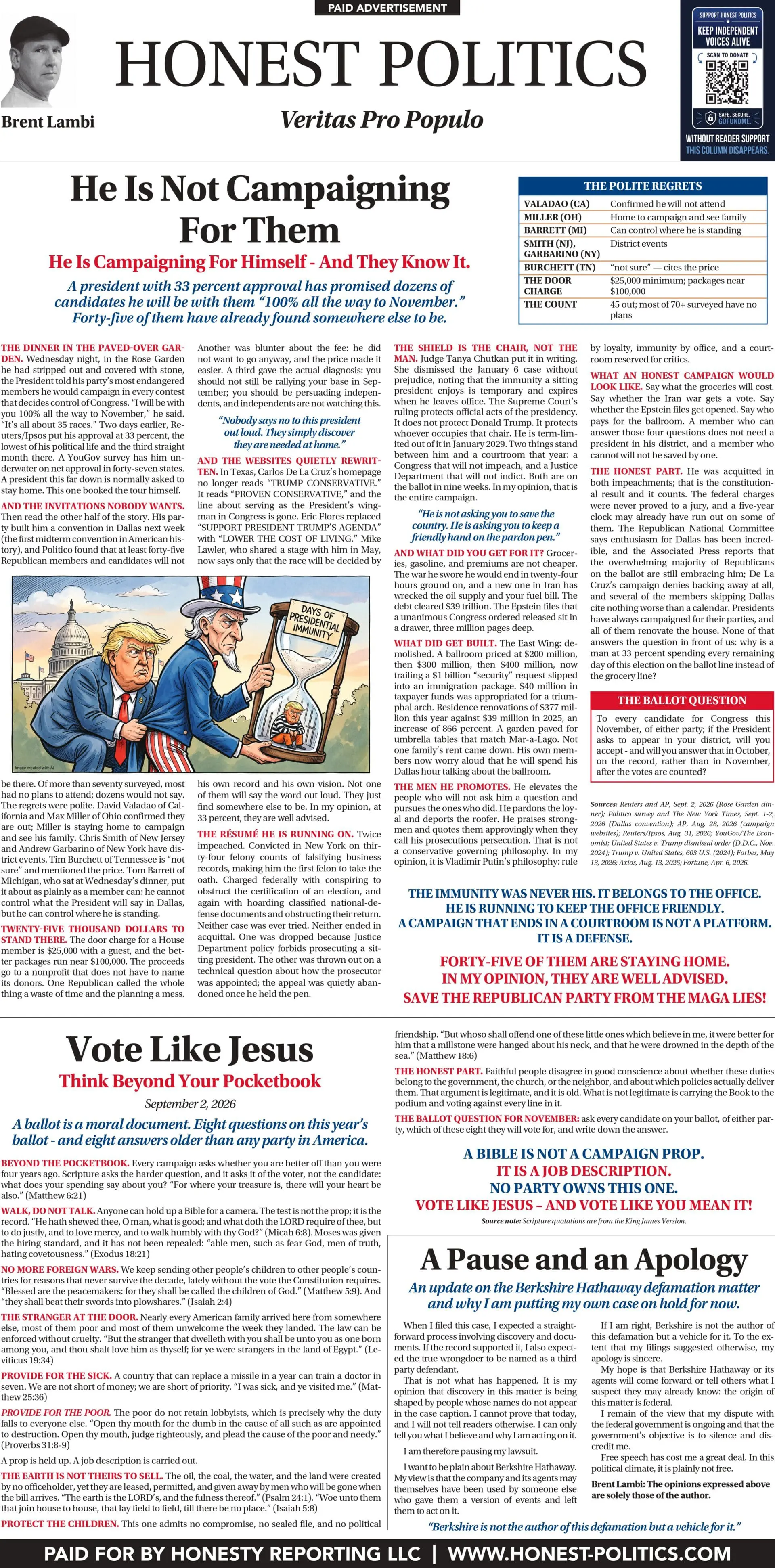
As seen in the Des Moines Register and the Omaha World-Herald: He Is Not Campaigning For Them / Vote Like Jesus / A Pause and an Apology
HONEST POLITICS
WITHOUT READER SUPPORT
THIS COLUMN DISAPPEARS.
Brent Lambi
He Is Not Campaigning
For Them
He Is Campaigning For Himself – And They Know It.
A president with 33 percent approval has promised dozens of
candidates he will be with them “100% all the way to November.”
Forty-five of them have already found somewhere else to be.
THE IMMUNITY WAS NEVER HIS. IT BELONGS TO THE OFFICE.
HE IS RUNNING TO KEEP THE OFFICE FRIENDLY.
A CAMPAIGN THAT ENDS IN A COURTROOM IS NOT A PLATFORM.
IT IS A DEFENSE.
FORTY-FIVE OF THEM ARE STAYING HOME.
IN MY OPINION, THEY ARE WELL ADVISED.
SAVE THE REPUBLICAN PARTY FROM THE MAGA LIES!
THE DINNER IN THE PAVED-OVER GARDEN.
Wednesday night, in the Rose Garden
he had stripped out and covered with stone,
the President told his party’s most endangered
members he would campaign in every contest
that decides control of Congress. “I will be with
you 100% all the way to November,” he said.
“It’s all about 35 races.” Two days earlier, Reuters/
Ipsos put his approval at 33 percent, the
lowest of his political life and the third straight
month there. A YouGov survey has him underwater
on net approval in forty-seven states.
A president this far down is normally asked to
stay home. This one booked the tour himself.
AND THE INVITATIONS NOBODY WANTS.
Then read the other half of the story. His party
built him a convention in Dallas next week
(the first midterm convention in American history),
and Politico found that at least forty-five
Republican members and candidates will not
be there. Of more than seventy surveyed, most
had no plans to attend; dozens would not say.
The regrets were polite. David Valadao of California
and Max Miller of Ohio confirmed they
are out; Miller is staying home to campaign
and see his family. Chris Smith of New Jersey
and Andrew Garbarino of New York have district
events. Tim Burchett of Tennessee is “not
sure” and mentioned the price. Tom Barrett of
Michigan, who sat at Wednesday’s dinner, put
it about as plainly as a member can: he cannot
control what the President will say in Dallas,
but he can control where he is standing.
TWENTY-FIVE THOUSAND DOLLARS TO
STAND THERE. The door charge for a House
member is $25,000 with a guest, and the better
packages run near $100,000. The proceeds
go to a nonprofit that does not have to name
its donors. One Republican called the whole
thing a waste of time and the planning a mess.
Another was blunter about the fee: he did
not want to go anyway, and the price made it
easier. A third gave the actual diagnosis: you
should not still be rallying your base in September;
you should be persuading independents,
and independents are not watching this.
“Nobody says no to this president
out loud. They simply discover
they are needed at home.”
AND THE WEBSITES QUIETLY REWRITTEN.
In Texas, Carlos De La Cruz’s homepage
no longer reads “TRUMP CONSERVATIVE.”
It reads “PROVEN CONSERVATIVE,” and the
line about serving as the President’s wingman
in Congress is gone. Eric Flores replaced
“SUPPORT PRESIDENT TRUMP’S AGENDA”
with “LOWER THE COST OF LIVING.” Mike
Lawler, who shared a stage with him in May,
now says only that the race will be decided by
his own record and his own vision. Not one
of them will say the word out loud. They just
find somewhere else to be. In my opinion, at
33 percent, they are well advised.
THE RÉSUMÉ HE IS RUNNING ON. Twice
impeached. Convicted in New York on thirty-
four felony counts of falsifying business
records, making him the first felon to take the
oath. Charged federally with conspiring to
obstruct the certification of an election, and
again with hoarding classified national-defense
documents and obstructing their return.
Neither case was ever tried. Neither ended in
acquittal. One was dropped because Justice
Department policy forbids prosecuting a sitting
president. The other was thrown out on a
technical question about how the prosecutor
was appointed; the appeal was quietly abandoned
once he held the pen.
Vote Like Jesus
Think Beyond Your Pocketbook
September 2, 2026
A ballot is a moral document. Eight questions on this year’s
ballot – and eight answers older than any party in America.
When I filed this case, I expected a straightforward
process involving discovery and documents.
If the record supported it, I also expected
the true wrongdoer to be named as a third
party defendant.
That is not what has happened. It is my
opinion that discovery in this matter is being
shaped by people whose names do not appear
in the case caption. I cannot prove that today,
and I will not tell readers otherwise. I can only
tell you what I believe and why I am acting on it.
I am therefore pausing my lawsuit.
I want to be plain about Berkshire Hathaway.
My view is that the company and its agents may
themselves have been used by someone else
who gave them a version of events and left
them to act on it.
If I am right, Berkshire is not the author of
this defamation but a vehicle for it. To the extent
that my filings suggested otherwise, my
apology is sincere.
My hope is that Berkshire Hathaway or its
agents will come forward or tell others what I
suspect they may already know: the origin of
this matter is federal.
I remain of the view that my dispute with
the federal government is ongoing and that the
government’s objective is to silence and discredit
me.
Free speech has cost me a great deal. In this
political climate, it is plainly not free.
Brent Lambi: The opinions expressed above
are solely those of the author.
A Pause and an Apology
An update on the Berkshire Hathaway defamation matter
and why I am putting my own case on hold for now.
“Berkshire is not the author of this defamation but a vehicle for it.”
A BIBLE IS NOT A CAMPAIGN PROP.
IT IS A JOB DESCRIPTION.
NO PARTY OWNS THIS ONE.
VOTE LIKE JESUS – AND VOTE LIKE YOU MEAN IT!
Source note: Scripture quotations are from the King James Version.
Confirmed he will not attend
Home to campaign and see family
Can control where he is standing
District events
“not sure” — cites the price
$25,000 minimum; packages near
$100,000
45 out; most of 70+ surveyed have no
plans
VALADAO (CA)
MILLER (OH)
BARRETT (MI)
SMITH (NJ),
GARBARINO (NY)
BURCHETT (TN)
THE DOOR
CHARGE
THE COUNT
THE POLITE REGRETS
THE SHIELD IS THE CHAIR, NOT THE
MAN. Judge Tanya Chutkan put it in writing.
She dismissed the January 6 case without
prejudice, noting that the immunity a sitting
president enjoys is temporary and expires
when he leaves office. The Supreme Court’s
ruling protects official acts of the presidency.
It does not protect Donald Trump. It protects
whoever occupies that chair. He is term-limited
out of it in January 2029. Two things stand
between him and a courtroom that year: a
Congress that will not impeach, and a Justice
Department that will not indict. Both are on
the ballot in nine weeks. In my opinion, that is
the entire campaign.
“He is not asking you to save the
country. He is asking you to keep a
friendly hand on the pardon pen.”
AND WHAT DID YOU GET FOR IT? Groceries,
gasoline, and premiums are not cheaper.
The war he swore he would end in twenty-four
hours ground on, and a new one in Iran has
wrecked the oil supply and your fuel bill. The
debt cleared $39 trillion. The Epstein files that
a unanimous Congress ordered released sit in
a drawer, three million pages deep.
WHAT DID GET BUILT. The East Wing: demolished.
A ballroom priced at $200 million,
then $300 million, then $400 million, now
trailing a $1 billion “security” request slipped
into an immigration package. $40 million in
taxpayer funds was appropriated for a triumphal
arch. Residence renovations of $377 million
this year against $39 million in 2025, an
increase of 866 percent. A garden paved for
umbrella tables that match Mar-a-Lago. Not
one family’s rent came down. His own members
now worry aloud that he will spend his
Dallas hour talking about the ballroom.
THE MEN HE PROMOTES. He elevates the
people who will not ask him a question and
pursues the ones who did. He pardons the loyal
and deports the roofer. He praises strongmen
and quotes them approvingly when they
call his prosecutions persecution. That is not
a conservative governing philosophy. In my
opinion, it is Vladimir Putin’s philosophy: rule
by loyalty, immunity by office, and a courtroom
reserved for critics.
WHAT AN HONEST CAMPAIGN WOULD
LOOK LIKE. Say what the groceries will cost.
Say whether the Iran war gets a vote. Say
whether the Epstein files get opened. Say who
pays for the ballroom. A member who can
answer those four questions does not need a
president in his district, and a member who
cannot will not be saved by one.
THE HONEST PART. He was acquitted in
both impeachments; that is the constitutional
result and it counts. The federal charges
were never proved to a jury, and a five-year
clock may already have run out on some of
them. The Republican National Committee
says enthusiasm for Dallas has been incredible,
and the Associated Press reports that
the overwhelming majority of Republicans
on the ballot are still embracing him; De La
Cruz’s campaign denies backing away at all,
and several of the members skipping Dallas
cite nothing worse than a calendar. Presidents
have always campaigned for their parties, and
all of them renovate the house. None of that
answers the question in front of us: why is a
man at 33 percent spending every remaining
day of this election on the ballot line instead of
the grocery line?
Sources: Reuters and AP, Sept. 2, 2026 (Rose Garden dinner);
Politico survey and The New York Times, Sept. 1-2,
2026 (Dallas convention); AP, Aug. 28, 2026 (campaign
websites); Reuters/Ipsos, Aug. 31, 2026; YouGov/The Economist;
United States v. Trump dismissal order (D.D.C., Nov.
2024); Trump v. United States, 603 U.S. (2024); Forbes, May
13, 2026; Axios, Aug. 13, 2026; Fortune, Apr. 6, 2026.
To every candidate for Congress this
November, of either party; if the President
asks to appear in your district, will you
accept – and will you answer that in October,
on the record, rather than in November,
after the votes are counted?
THE BALLOT QUESTION
BEYOND THE POCKETBOOK. Every campaign asks whether you are better off than you were
four years ago. Scripture asks the harder question, and it asks it of the voter, not the candidate:
what does your spending say about you? “For where your treasure is, there will your heart be
also.” (Matthew 6:21)
WALK, DO NOT TALK. Anyone can hold up a Bible for a camera. The test is not the prop; it is the
record. “He hath shewed thee, O man, what is good; and what doth the LORD require of thee, but
to do justly, and to love mercy, and to walk humbly with thy God?” (Micah 6:8). Moses was given
the hiring standard, and it has not been repealed: “able men, such as fear God, men of truth,
hating covetousness.” (Exodus 18:21)
NO MORE FOREIGN WARS. We keep sending other people’s children to other people’s countries
for reasons that never survive the decade, lately without the vote the Constitution requires.
“Blessed are the peacemakers: for they shall be called the children of God.” (Matthew 5:9). And
“they shall beat their swords into plowshares.” (Isaiah 2:4)
THE STRANGER AT THE DOOR. Nearly every American family arrived here from somewhere
else, most of them poor and most of them unwelcome the week they landed. The law can be
enforced without cruelty. “But the stranger that dwelleth with you shall be unto you as one born
among you, and thou shalt love him as thyself; for ye were strangers in the land of Egypt.” (Leviticus
19:34)
PROVIDE FOR THE SICK. A country that can replace a missile in a year can train a doctor in
seven. We are not short of money; we are short of priority. “I was sick, and ye visited me.” (Matthew
25:36)
PROVIDE FOR THE POOR. The poor do not retain lobbyists, which is precisely why the duty
falls to everyone else. “Open thy mouth for the dumb in the cause of all such as are appointed
to destruction. Open thy mouth, judge righteously, and plead the cause of the poor and needy.”
(Proverbs 31:8-9)
A prop is held up. A job description is carried out.
THE EARTH IS NOT THEIRS TO SELL. The oil, the coal, the water, and the land were created
by no officeholder, yet they are leased, permitted, and given away by men who will be gone when
the bill arrives. “The earth is the LORD’s, and the fulness thereof.” (Psalm 24:1). “Woe unto them
that join house to house, that lay field to field, till there be no place.” (Isaiah 5:8)
PROTECT THE CHILDREN. This one admits no compromise, no sealed file, and no political
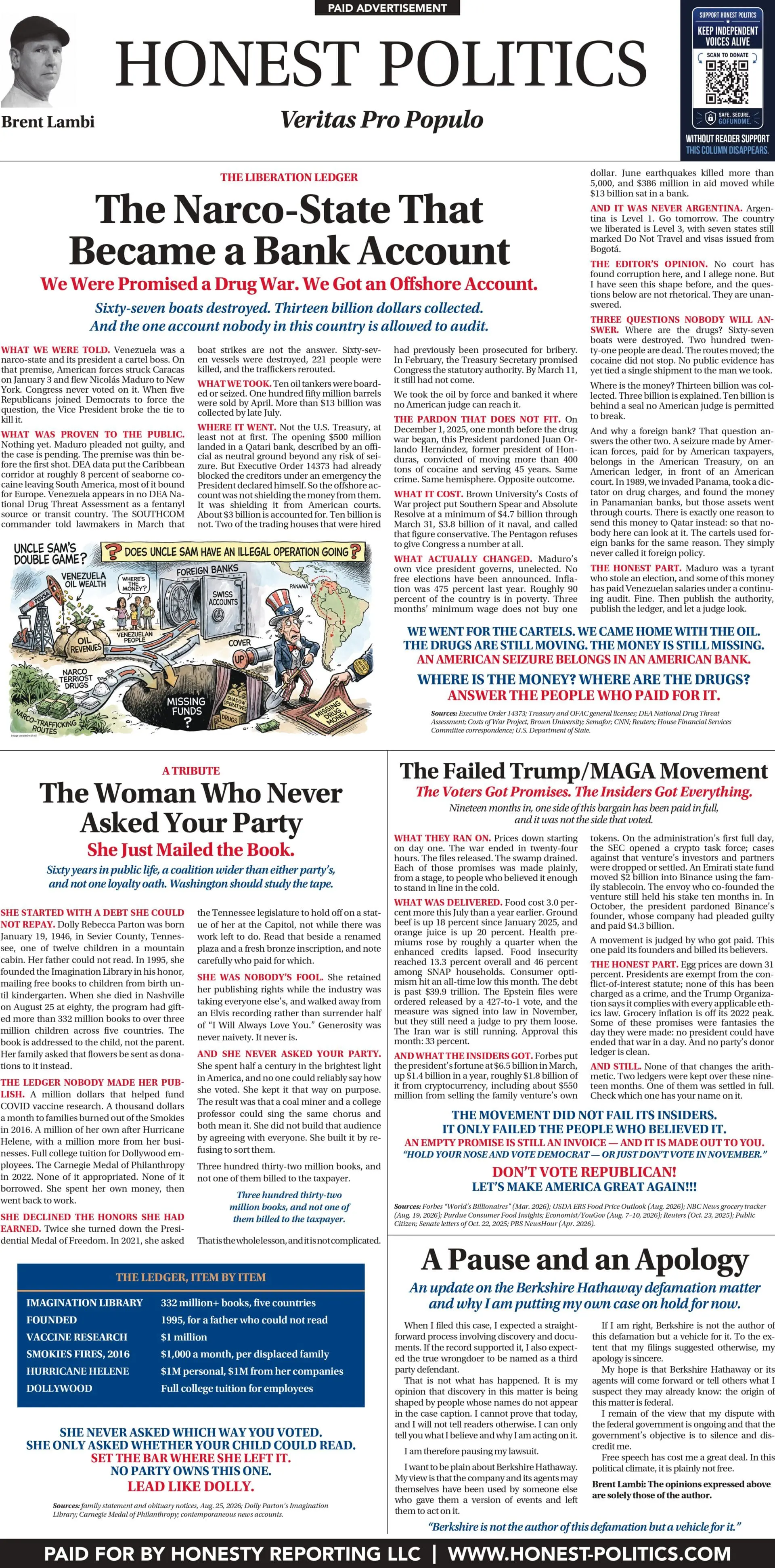
As Seen in the Des Moines Register and the Omaha World-Herald: The Narco-State That Became a Bank Account / The Woman Who Never Asked Your Party / The Failed Trump MAGA Movement / A Pause and an Apology
Narco-State That
Became a Bank Account
We Were Promised a Drug War. We Got an Offshore Account.
Sixty-seven boats destroyed. Thirteen billion dollars collected.
And the one account nobody in this country is allowed to audit.
IMAGINATION LIBRARY 332 million+ books, five countries
FOUNDED 1995, for a father who could not read
VACCINE RESEARCH $1 million
SMOKIES FIRES, 2016 $1,000 a month, per displaced family
HURRICANE HELENE $1M personal, $1M from her companies
DOLLYWOOD Full college tuition for employees
THE LEDGER, ITEM BY ITEM
WE WENT FOR THE CARTELS. WE CAME HOME WITH THE OIL.
THE DRUGS ARE STILL MOVING. THE MONEY IS STILL MISSING.
AN AMERICAN SEIZURE BELONGS IN AN AMERICAN BANK.
WHERE IS THE MONEY? WHERE ARE THE DRUGS?
ANSWER THE PEOPLE WHO PAID FOR IT.
WHAT WE WERE TOLD. Venezuela was a
narco-state and its president a cartel boss. On
that premise, American forces struck Caracas
on January 3 and flew Nicolás Maduro to New
York. Congress never voted on it. When five
Republicans joined Democrats to force the
question, the Vice President broke the tie to
kill it.
WHAT WAS PROVEN TO THE PUBLIC.
Nothing yet. Maduro pleaded not guilty, and
the case is pending. The premise was thin before
the first shot. DEA data put the Caribbean
corridor at roughly 8 percent of seaborne cocaine
leaving South America, most of it bound
for Europe. Venezuela appears in no DEA National
Drug Threat Assessment as a fentanyl
source or transit country. The SOUTHCOM
commander told lawmakers in March that
boat strikes are not the answer. Sixty-seven
vessels were destroyed, 221 people were
killed, and the traffickers rerouted.
WHAT WE TOOK. Ten oil tankers were boarded
or seized. One hundred fifty million barrels
were sold by April. More than $13 billion was
collected by late July.
WHERE IT WENT. Not the U.S. Treasury, at
least not at first. The opening $500 million
landed in a Qatari bank, described by an official
as neutral ground beyond any risk of seizure.
But Executive Order 14373 had already
blocked the creditors under an emergency the
President declared himself. So the offshore account
was not shielding the money from them.
It was shielding it from American courts.
About $3 billion is accounted for. Ten billion is
not. Two of the trading houses that were hired
had previously been prosecuted for bribery.
In February, the Treasury Secretary promised
Congress the statutory authority. By March 11,
it still had not come.
We took the oil by force and banked it where
no American judge can reach it.
THE PARDON THAT DOES NOT FIT. On
December 1, 2025, one month before the drug
war began, this President pardoned Juan Orlando
Hernández, former president of Honduras,
convicted of moving more than 400
tons of cocaine and serving 45 years. Same
crime. Same hemisphere. Opposite outcome.
WHAT IT COST. Brown University’s Costs of
War project put Southern Spear and Absolute
Resolve at a minimum of $4.7 billion through
March 31, $3.8 billion of it naval, and called
that figure conservative. The Pentagon refuses
to give Congress a number at all.
WHAT ACTUALLY CHANGED. Maduro’s
own vice president governs, unelected. No
free elections have been announced. Inflation
was 475 percent last year. Roughly 90
percent of the country is in poverty. Three
months’ minimum wage does not buy one
dollar. June earthquakes killed more than
5,000, and $386 million in aid moved while
$13 billion sat in a bank.
AND IT WAS NEVER ARGENTINA. Argentina
is Level 1. Go tomorrow. The country
we liberated is Level 3, with seven states still
marked Do Not Travel and visas issued from
Bogotá.
THE EDITOR’S OPINION. No court has
found corruption here, and I allege none. But
I have seen this shape before, and the questions
below are not rhetorical. They are unanswered.
THREE QUESTIONS NOBODY WILL ANSWER.
Where are the drugs? Sixty-seven
boats were destroyed. Two hundred twenty-
one people are dead. The routes moved; the
cocaine did not stop. No public evidence has
yet tied a single shipment to the man we took.
Where is the money? Thirteen billion was collected.
Three billion is explained. Ten billion is
behind a seal no American judge is permitted
to break.
And why a foreign bank? That question answers
the other two. A seizure made by American
forces, paid for by American taxpayers,
belongs in the American Treasury, on an
American ledger, in front of an American
court. In 1989, we invaded Panama, took a dictator
on drug charges, and found the money
in Panamanian banks, but those assets went
through courts. There is exactly one reason to
send this money to Qatar instead: so that nobody
here can look at it. The cartels used foreign
banks for the same reason. They simply
never called it foreign policy.
THE HONEST PART. Maduro was a tyrant
who stole an election, and some of this money
has paid Venezuelan salaries under a continuing
audit. Fine. Then publish the authority,
publish the ledger, and let a judge look.
A TRIBUTE
The Woman Who Never
Asked Your Party
She Just Mailed the Book.
Sixty years in public life, a coalition wider than either party’s,
and not one loyalty oath. Washington should study the tape.
The Failed Trump/MAGA Movement
The Voters Got Promises. The Insiders Got Everything.
Nineteen months in, one side of this bargain has been paid in full,
and it was not the side that voted.
When I filed this case, I expected a straightforward
process involving discovery and documents.
If the record supported it, I also expected
the true wrongdoer to be named as a third
party defendant.
That is not what has happened. It is my
opinion that discovery in this matter is being
shaped by people whose names do not appear
in the case caption. I cannot prove that today,
and I will not tell readers otherwise. I can only
tell you what I believe and why I am acting on it.
I am therefore pausing my lawsuit.
I want to be plain about Berkshire Hathaway.
My view is that the company and its agents may
themselves have been used by someone else
who gave them a version of events and left
them to act on it.
If I am right, Berkshire is not the author of
this defamation but a vehicle for it. To the extent
that my filings suggested otherwise, my
apology is sincere.
My hope is that Berkshire Hathaway or its
agents will come forward or tell others what I
suspect they may already know: the origin of
this matter is federal.
I remain of the view that my dispute with
the federal government is ongoing and that the
government’s objective is to silence and discredit
me.
Free speech has cost me a great deal. In this
political climate, it is plainly not free.
Brent Lambi: The opinions expressed above
are solely those of the author.
A Pause and an Apology
An update on the Berkshire Hathaway defamation matter
and why I am putting my own case on hold for now.
“Berkshire is not the author of this defamation but a vehicle for it.”
Sources: Forbes “World’s Billionaires” (Mar. 2026); USDA ERS Food Price Outlook (Aug. 2026); NBC News grocery tracker
(Aug. 19, 2026); Purdue Consumer Food Insights; Economist/YouGov (Aug. 7–10, 2026); Reuters (Oct. 23, 2025); Public
Citizen; Senate letters of Oct. 22, 2025; PBS NewsHour (Apr. 2026).
Sources: Executive Order 14373; Treasury and OFAC general licenses; DEA National Drug Threat
Assessment; Costs of War Project, Brown University; Semafor; CNN; Reuters; House Financial Services
Committee correspondence; U.S. Department of State.
SHE STARTED WITH A DEBT SHE COULD
NOT REPAY. Dolly Rebecca Parton was born
January 19, 1946, in Sevier County, Tennessee,
one of twelve children in a mountain
cabin. Her father could not read. In 1995, she
founded the Imagination Library in his honor,
mailing free books to children from birth until
kindergarten. When she died in Nashville
on August 25 at eighty, the program had gifted
more than 332 million books to over three
million children across five countries. The
book is addressed to the child, not the parent.
Her family asked that flowers be sent as donations
to it instead.
THE LEDGER NOBODY MADE HER PUBLISH.
A million dollars that helped fund
COVID vaccine research. A thousand dollars
a month to families burned out of the Smokies
in 2016. A million of her own after Hurricane
Helene, with a million more from her businesses.
Full college tuition for Dollywood employees.
The Carnegie Medal of Philanthropy
in 2022. None of it appropriated. None of it
borrowed. She spent her own money, then
went back to work.
SHE DECLINED THE HONORS SHE HAD
EARNED. Twice she turned down the Presidential
Medal of Freedom. In 2021, she asked
the Tennessee legislature to hold off on a statue
of her at the Capitol, not while there was
work left to do. Read that beside a renamed
plaza and a fresh bronze inscription, and note
carefully who paid for which.
SHE WAS NOBODY’S FOOL. She retained
her publishing rights while the industry was
taking everyone else’s, and walked away from
an Elvis recording rather than surrender half
of “I Will Always Love You.” Generosity was
never naivety. It never is.
AND SHE NEVER ASKED YOUR PARTY.
She spent half a century in the brightest light
in America, and no one could reliably say how
she voted. She kept it that way on purpose.
The result was that a coal miner and a college
professor could sing the same chorus and
both mean it. She did not build that audience
by agreeing with everyone. She built it by refusing
to sort them.
Three hundred thirty-two million books, and
not one of them billed to the taxpayer.
Three hundred thirty-two
million books, and not one of
them billed to the taxpayer.
That is the whole lesson, and it is not complicated.
SHE NEVER ASKED WHICH WAY YOU VOTED.
SHE ONLY ASKED WHETHER YOUR CHILD COULD READ.
SET THE BAR WHERE SHE LEFT IT.
NO PARTY OWNS THIS ONE.
LEAD LIKE DOLLY.
Sources: family statement and obituary notices, Aug. 25, 2026; Dolly Parton’s Imagination
Library; Carnegie Medal of Philanthropy; contemporaneous news accounts.
WHAT THEY RAN ON. Prices down starting
on day one. The war ended in twenty-four
hours. The files released. The swamp drained.
Each of those promises was made plainly,
from a stage, to people who believed it enough
to stand in line in the cold.
WHAT WAS DELIVERED. Food cost 3.0 percent
more this July than a year earlier. Ground
beef is up 18 percent since January 2025, and
orange juice is up 20 percent. Health premiums
rose by roughly a quarter when the
enhanced credits lapsed. Food insecurity
reached 13.3 percent overall and 46 percent
among SNAP households. Consumer optimism
hit an all-time low this month. The debt
is past $39.9 trillion. The Epstein files were
ordered released by a 427-to-1 vote, and the
measure was signed into law in November,
but they still need a judge to pry them loose.
The Iran war is still running. Approval this
month: 33 percent.
AND WHAT THE INSIDERS GOT. Forbes put
the president’s fortune at $6.5 billion in March,
up $1.4 billion in a year, roughly $1.8 billion of
it from cryptocurrency, including about $550
million from selling the family venture’s own
tokens. On the administration’s first full day,
the SEC opened a crypto task force; cases
against that venture’s investors and partners
were dropped or settled. An Emirati state fund
moved $2 billion into Binance using the family
stablecoin. The envoy who co-founded the
venture still held his stake ten months in. In
October, the president pardoned Binance’s
founder, whose company had pleaded guilty
and paid $4.3 billion.
A movement is judged by who got paid. This
one paid its founders and billed its believers.
THE HONEST PART. Egg prices are down 31
percent. Presidents are exempt from the conflict-
of-interest statute; none of this has been
charged as a crime, and the Trump Organization
says it complies with every applicable ethics
law. Grocery inflation is off its 2022 peak.
Some of these promises were fantasies the
day they were made: no president could have
ended that war in a day. And no party’s donor
ledger is clean.
AND STILL. None of that changes the arithmetic.
Two ledgers were kept over these nineteen
months. One of them was settled in full.
Check which one has your name on it.
THE MOVEMENT DID NOT FAIL ITS INSIDERS.
IT ONLY FAILED THE PEOPLE WHO BELIEVED IT.
AN EMPTY PROMISE IS STILL AN INVOICE — AND IT IS MADE OUT TO YOU.
“HOLD YOUR NOSE AND VOTE DEMOCRAT — OR JUST DON’T VOTE IN NOVEMBER.”
DON’T VOTE REPUBLICAN!
LET’S MAKE AMERICA GREAT AGAIN!!!
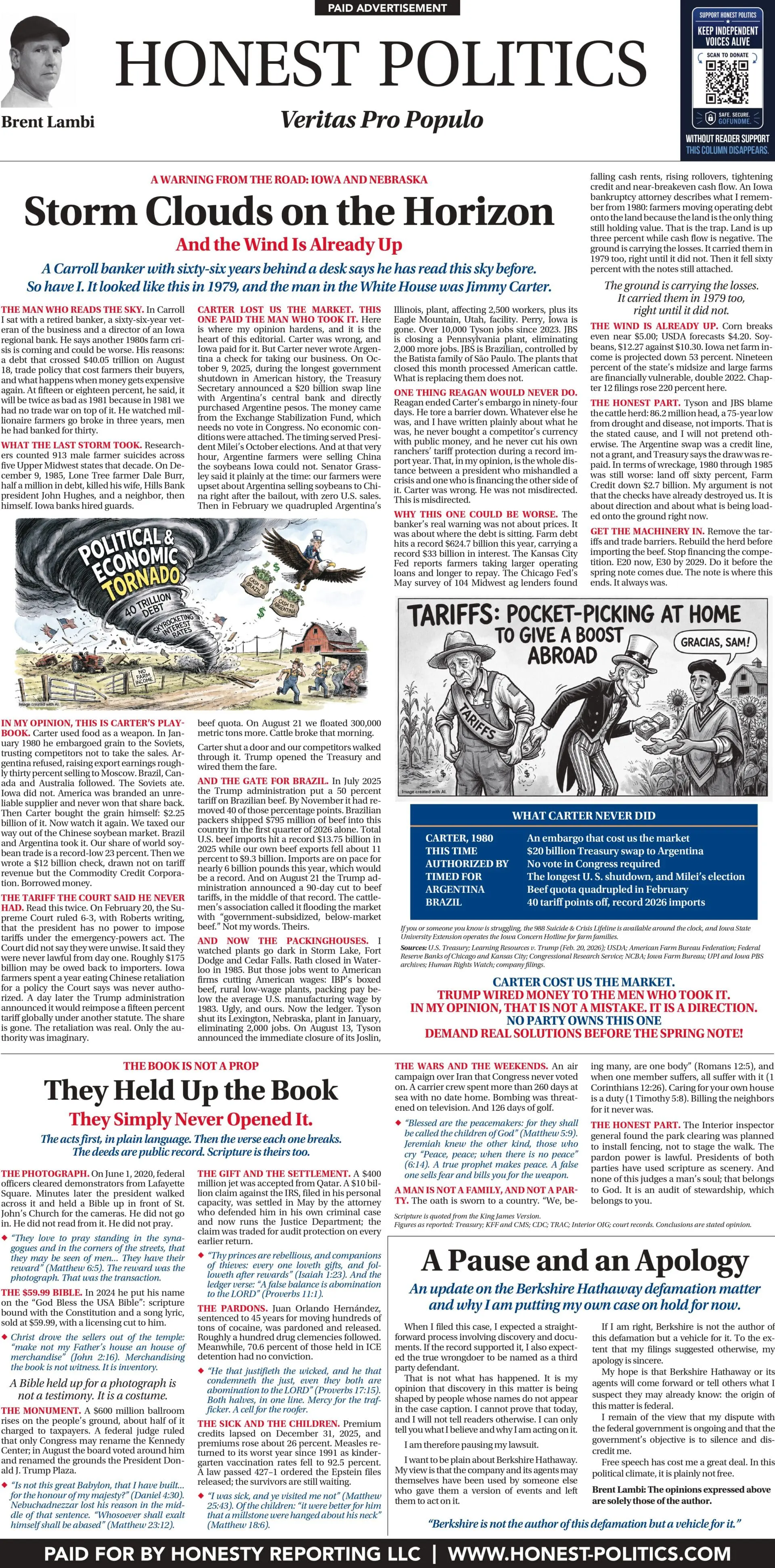
As Seen in the Des Moines Register and the Omaha World-Herald: Storm Clouds on the Horizon / They Held Up the Book / A Pause and an Apology
A WARNING FROM THE ROAD: IOWA AND NEBRASKA
Storm Clouds on the Horizon
And the Wind Is Already Up
A Carroll banker with sixty-six years behind a desk says he has read this sky before.
So have I. It looked like this in 1979, and the man in the White House was Jimmy Carter.
If you or someone you know is struggling, the 988 Suicide & Crisis Lifeline is available around the clock, and Iowa State
University Extension operates the Iowa Concern Hotline for farm families.
Sources: U.S. Treasury; Learning Resources v. Trump (Feb. 20, 2026); USDA; American Farm Bureau Federation; Federal
Reserve Banks of Chicago and Kansas City; Congressional Research Service; NCBA; Iowa Farm Bureau; UPI and Iowa PBS
archives; Human Rights Watch; company filings.
CARTER, 1980 An embargo that cost us the market
THIS TIME $20 billion Treasury swap to Argentina
AUTHORIZED BY No vote in Congress required
TIMED FOR The longest U. S. shutdown, and Milei’s election
ARGENTINA Beef quota quadrupled in February
BRAZIL 40 tariff points off, record 2026 imports
WHAT CARTER NEVER DID
CARTER COST US THE MARKET.
TRUMP WIRED MONEY TO THE MEN WHO TOOK IT.
IN MY OPINION, THAT IS NOT A MISTAKE. IT IS A DIRECTION.
NO PARTY OWNS THIS ONE
DEMAND REAL SOLUTIONS BEFORE THE SPRING NOTE!
THE MAN WHO READS THE SKY. In Carroll
I sat with a retired banker, a sixty-six-year veteran
of the business and a director of an Iowa
regional bank. He says another 1980s farm crisis
is coming and could be worse. His reasons:
a debt that crossed $40.05 trillion on August
18, trade policy that cost farmers their buyers,
and what happens when money gets expensive
again. At fifteen or eighteen percent, he said, it
will be twice as bad as 1981 because in 1981 we
had no trade war on top of it. He watched millionaire
farmers go broke in three years, men
he had banked for thirty.
WHAT THE LAST STORM TOOK. Researchers
counted 913 male farmer suicides across
five Upper Midwest states that decade. On December
9, 1985, Lone Tree farmer Dale Burr,
half a million in debt, killed his wife, Hills Bank
president John Hughes, and a neighbor, then
himself. Iowa banks hired guards.
IN MY OPINION, THIS IS CARTER’S PLAYBOOK.
Carter used food as a weapon. In January
1980 he embargoed grain to the Soviets,
trusting competitors not to take the sales. Argentina
refused, raising export earnings roughly
thirty percent selling to Moscow. Brazil, Canada
and Australia followed. The Soviets ate.
Iowa did not. America was branded an unreliable
supplier and never won that share back.
Then Carter bought the grain himself: $2.25
billion of it. Now watch it again. We taxed our
way out of the Chinese soybean market. Brazil
and Argentina took it. Our share of world soybean
trade is a record-low 23 percent. Then we
wrote a $12 billion check, drawn not on tariff
revenue but the Commodity Credit Corporation.
Borrowed money.
THE TARIFF THE COURT SAID HE NEVER
HAD. Read this twice. On February 20, the Supreme
Court ruled 6-3, with Roberts writing,
that the president has no power to impose
tariffs under the emergency-powers act. The
Court did not say they were unwise. It said they
were never lawful from day one. Roughly $175
billion may be owed back to importers. Iowa
farmers spent a year eating Chinese retaliation
for a policy the Court says was never authorized.
A day later the Trump administration
announced it would reimpose a fifteen percent
tariff globally under another statute. The share
is gone. The retaliation was real. Only the authority
was imaginary.
CARTER LOST US THE MARKET. THIS
ONE PAID THE MAN WHO TOOK IT. Here
is where my opinion hardens, and it is the
heart of this editorial. Carter was wrong, and
Iowa paid for it. But Carter never wrote Argentina
a check for taking our business. On October
9, 2025, during the longest government
shutdown in American history, the Treasury
Secretary announced a $20 billion swap line
with Argentina’s central bank and directly
purchased Argentine pesos. The money came
from the Exchange Stabilization Fund, which
needs no vote in Congress. No economic conditions
were attached. The timing served President
Milei’s October elections. And at that very
hour, Argentine farmers were selling China
the soybeans Iowa could not. Senator Grassley
said it plainly at the time: our farmers were
upset about Argentina selling soybeans to China
right after the bailout, with zero U.S. sales.
Then in February we quadrupled Argentina’s
beef quota. On August 21 we floated 300,000
metric tons more. Cattle broke that morning.
Carter shut a door and our competitors walked
through it. Trump opened the Treasury and
wired them the fare.
AND THE GATE FOR BRAZIL. In July 2025
the Trump administration put a 50 percent
tariff on Brazilian beef. By November it had removed
40 of those percentage points. Brazilian
packers shipped $795 million of beef into this
country in the first quarter of 2026 alone. Total
U.S. beef imports hit a record $13.75 billion in
2025 while our own beef exports fell about 11
percent to $9.3 billion. Imports are on pace for
nearly 6 billion pounds this year, which would
be a record. And on August 21 the Trump administration
announced a 90-day cut to beef
tariffs, in the middle of that record. The cattlemen’s
association called it flooding the market
with “government-subsidized, below-market
beef.” Not my words. Theirs.
AND NOW THE PACKINGHOUSES. I
watched plants go dark in Storm Lake, Fort
Dodge and Cedar Falls. Rath closed in Waterloo
in 1985. But those jobs went to American
firms cutting American wages: IBP’s boxed
beef, rural low-wage plants, packing pay below
the average U.S. manufacturing wage by
1983. Ugly, and ours. Now the ledger. Tyson
shut its Lexington, Nebraska, plant in January,
eliminating 2,000 jobs. On August 13, Tyson
announced the immediate closure of its Joslin,
Illinois, plant, affecting 2,500 workers, plus its
Eagle Mountain, Utah, facility. Perry, Iowa is
gone. Over 10,000 Tyson jobs since 2023. JBS
is closing a Pennsylvania plant, eliminating
2,000 more jobs. JBS is Brazilian, controlled by
the Batista family of São Paulo. The plants that
closed this month processed American cattle.
What is replacing them does not.
ONE THING REAGAN WOULD NEVER DO.
Reagan ended Carter’s embargo in ninety-four
days. He tore a barrier down. Whatever else he
was, and I have written plainly about what he
was, he never bought a competitor’s currency
with public money, and he never cut his own
ranchers’ tariff protection during a record import
year. That, in my opinion, is the whole distance
between a president who mishandled a
crisis and one who is financing the other side of
it. Carter was wrong. He was not misdirected.
This is misdirected.
WHY THIS ONE COULD BE WORSE. The
banker’s real warning was not about prices. It
was about where the debt is sitting. Farm debt
hits a record $624.7 billion this year, carrying a
record $33 billion in interest. The Kansas City
Fed reports farmers taking larger operating
loans and longer to repay. The Chicago Fed’s
May survey of 104 Midwest ag lenders found
falling cash rents, rising rollovers, tightening
credit and near-breakeven cash flow. An Iowa
bankruptcy attorney describes what I remember
from 1980: farmers moving operating debt
onto the land because the land is the only thing
still holding value. That is the trap. Land is up
three percent while cash flow is negative. The
ground is carrying the losses. It carried them in
1979 too, right until it did not. Then it fell sixty
percent with the notes still attached.
The ground is carrying the losses.
It carried them in 1979 too,
right until it did not.
THE WIND IS ALREADY UP. Corn breaks
even near $5.00; USDA forecasts $4.20. Soybeans,
$12.27 against $10.30. Iowa net farm income
is projected down 53 percent. Nineteen
percent of the state’s midsize and large farms
are financially vulnerable, double 2022. Chapter
12 filings rose 220 percent here.
THE HONEST PART. Tyson and JBS blame
the cattle herd: 86.2 million head, a 75-year low
from drought and disease, not imports. That is
the stated cause, and I will not pretend otherwise.
The Argentine swap was a credit line,
not a grant, and Treasury says the draw was repaid.
In terms of wreckage, 1980 through 1985
was still worse: land off sixty percent, Farm
Credit down $2.7 billion. My argument is not
that the checks have already destroyed us. It is
about direction and about what is being loaded
onto the ground right now.
GET THE MACHINERY IN. Remove the tariffs
and trade barriers. Rebuild the herd before
importing the beef. Stop financing the competition.
E20 now, E30 by 2029. Do it before the
spring note comes due. The note is where this
ends. It always was.
When I filed this case, I expected a straightforward
process involving discovery and documents.
If the record supported it, I also expected
the true wrongdoer to be named as a third
party defendant.
That is not what has happened. It is my
opinion that discovery in this matter is being
shaped by people whose names do not appear
in the case caption. I cannot prove that today,
and I will not tell readers otherwise. I can only
tell you what I believe and why I am acting on it.
I am therefore pausing my lawsuit.
I want to be plain about Berkshire Hathaway.
My view is that the company and its agents may
themselves have been used by someone else
who gave them a version of events and left
them to act on it.
If I am right, Berkshire is not the author of
this defamation but a vehicle for it. To the extent
that my filings suggested otherwise, my
apology is sincere.
My hope is that Berkshire Hathaway or its
agents will come forward or tell others what I
suspect they may already know: the origin of
this matter is federal.
I remain of the view that my dispute with
the federal government is ongoing and that the
government’s objective is to silence and discredit
me.
Free speech has cost me a great deal. In this
political climate, it is plainly not free.
Brent Lambi: The opinions expressed above
are solely those of the author.
A Pause and an Apology
An update on the Berkshire Hathaway defamation matter
and why I am putting my own case on hold for now.
THE BOOK IS NOT A PROP
They Held Up the Book
They Simply Never Opened It.
The acts first, in plain language. Then the verse each one breaks.
The deeds are public record. Scripture is theirs too.
THE PHOTOGRAPH. On June 1, 2020, federal
officers cleared demonstrators from Lafayette
Square. Minutes later the president walked
across it and held a Bible up in front of St.
John’s Church for the cameras. He did not go
in. He did not read from it. He did not pray.
◆ “They love to pray standing in the synagogues
and in the corners of the streets, that
they may be seen of men… They have their
reward” (Matthew 6:5). The reward was the
photograph. That was the transaction.
THE $59.99 BIBLE. In 2024 he put his name
on the “God Bless the USA Bible”: scripture
bound with the Constitution and a song lyric,
sold at $59.99, with a licensing cut to him.
◆ Christ drove the sellers out of the temple:
“make not my Father’s house an house of
merchandise” (John 2:16). Merchandising
the book is not witness. It is inventory.
A Bible held up for a photograph is
not a testimony. It is a costume.
THE MONUMENT. A $600 million ballroom
rises on the people’s ground, about half of it
charged to taxpayers. A federal judge ruled
that only Congress may rename the Kennedy
Center; in August the board voted around him
and renamed the grounds the President Donald
J. Trump Plaza.
◆ “Is not this great Babylon, that I have built…
for the honour of my majesty?” (Daniel 4:30).
Nebuchadnezzar lost his reason in the middle
of that sentence. “Whosoever shall exalt
himself shall be abased” (Matthew 23:12).
THE GIFT AND THE SETTLEMENT. A $400
million jet was accepted from Qatar. A $10 billion
claim against the IRS, filed in his personal
capacity, was settled in May by the attorney
who defended him in his own criminal case
and now runs the Justice Department; the
claim was traded for audit protection on every
earlier return.
◆ “Thy princes are rebellious, and companions
of thieves: every one loveth gifts, and followeth
after rewards” (Isaiah 1:23). And the
ledger verse: “A false balance is abomination
to the LORD” (Proverbs 11:1).
THE PARDONS. Juan Orlando Hernández,
sentenced to 45 years for moving hundreds of
tons of cocaine, was pardoned and released.
Roughly a hundred drug clemencies followed.
Meanwhile, 70.6 percent of those held in ICE
detention had no conviction.
◆ “He that justifieth the wicked, and he that
condemneth the just, even they both are
abomination to the LORD” (Proverbs 17:15).
Both halves, in one line. Mercy for the trafficker.
A cell for the roofer.
THE SICK AND THE CHILDREN. Premium
credits lapsed on December 31, 2025, and
premiums rose about 26 percent. Measles returned
to its worst year since 1991 as kindergarten
vaccination rates fell to 92.5 percent.
A law passed 427–1 ordered the Epstein files
released; the survivors are still waiting.
◆ “I was sick, and ye visited me not” (Matthew
25:43). Of the children: “it were better for him
that a millstone were hanged about his neck”