
As always, I want to thank all of the readers who have sent messages of support and financial assistance. Please visit my Go Fund Me if you’d like to help me keep this column going.

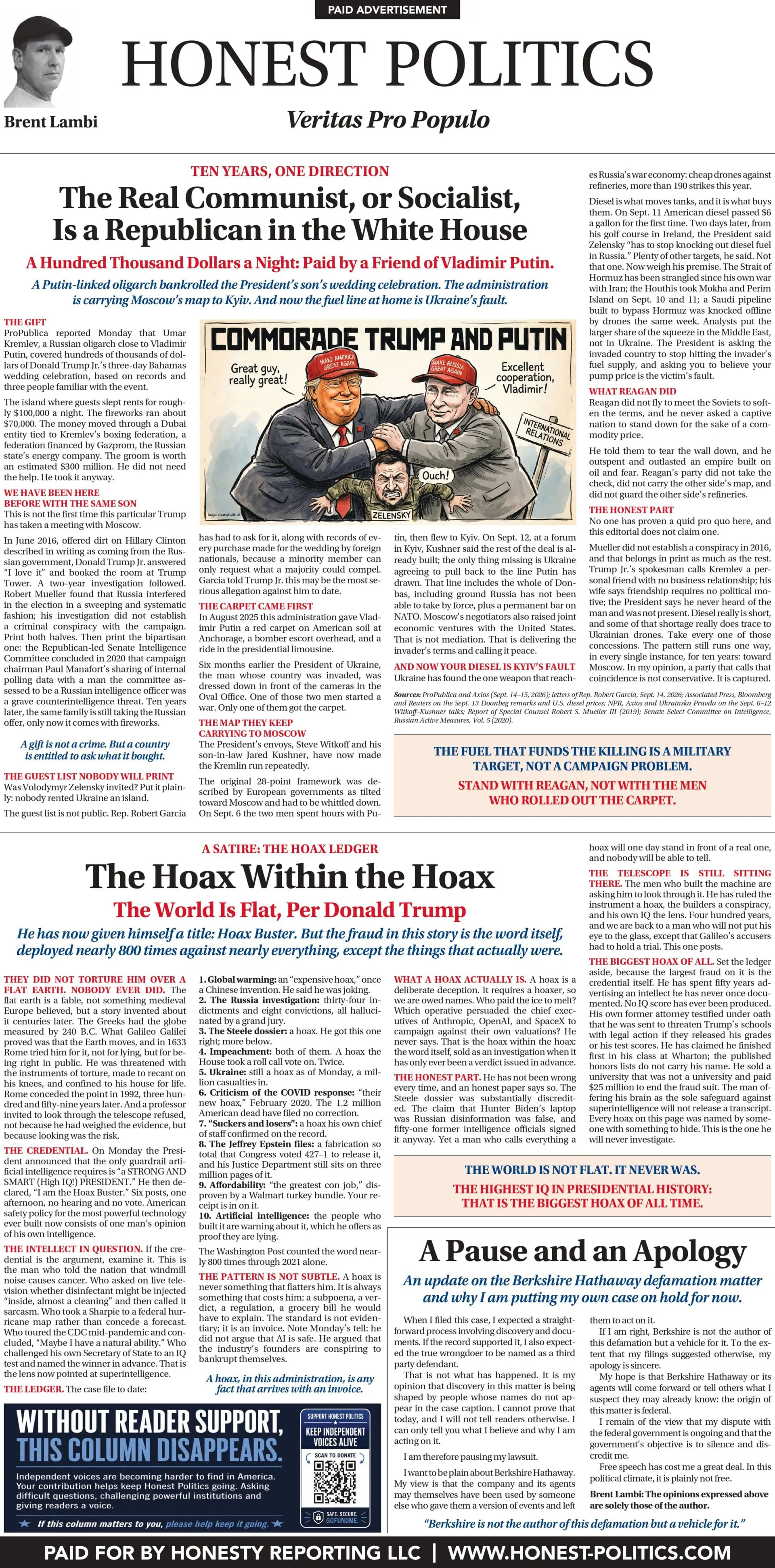
As Seen in the Omaha World-Herald: The Real Communist, or Socialist, Is a Republican in the White House / The Hoax Within the Hoax / A Pause and an Apology

by | Sep 18, 2026 | Political

Explore More from Brent Lambi

As Seen in the Omaha World-Herald: What Will 2126 say About Us? / Name the Bad Actors

As Seen in the Omaha World-Herald: What Will 2126 say About Us? / Name the Bad Actors

What Will 2126 Say About Us?
In 1926 a homemade rocket flew 41 feet and landed in a cabbage patch. Forty-three years later,
men walked on the Moon. What are we shrugging at today that our great-grandchildren will
take for granted?
“The man with a new idea is a Crank until the idea succeeds.” — Mark Twain, Following the Equator
◆
ne hundred years ago this autumn, Charles
Lindbergh had not yet flown across the
Atlantic. That flight was still six months
away, and the experts were not sure it could be done.
In most American kitchens the “refrigerator” was an
icebox, and the iceman still made his rounds. The
electric refrigerator was a luxury few families had
ever seen.
The miracle of the age was the radio — a wooden
cabinet that pulled voices and music out of thin air.
This very month, November 1926, a new outfit
called the National Broadcasting Company signed
on, stitching local stations into a national network.
Families gathered around the set the way we now
gather around our phones: mesmerized.
THE WORLD WITHOUT
A baby born in America that year could expect to
live to about 57. There was no penicillin; Alexander
Fleming would not notice the mold on his petri dish
until 1928. A scratched knee could turn into a
funeral. Polio emptied the swimming pools every
summer. Insulin was only four years old. Nobody
had heard of DNA.
THE ROCKET IN THE CABBAGE PATCH
That March, on his Aunt Effie’s farm in Auburn,
Massachusetts, a physics professor named Robert
Goddard lit the world’s first liquid-fueled rocket. It
flew for two and a half seconds, climbed 41 feet, and
came down in a cabbage patch.
Six years earlier, the New York Times had
ridiculed Goddard in an editorial, suggesting he did
not understand high-school physics. The paper got
around to correcting itself on July 17, 1969 — the
day after Apollo 11 left for the Moon. Forty-three
years from cabbage patch to Tranquility Base.
“The dream of yesterday is the hope of
today and the reality of tomorrow.”
— ROBERT H. GODDARD
And the story is not over. This past April, Artemis
II carried four astronauts around the Moon and
farther from Earth than any human beings have ever
traveled.
WHAT ONE CENTURY BOUGHT US
According to the CDC’s final figures, an American
baby born in 2024 can expect to live 79 years — the
highest in our history. That is more than twenty extra
years of life, handed to us by vaccines, antibiotics,
clean water, and people whose names most of us
never learned. Smallpox is gone from the face of the
earth. Gene therapies now rewrite the faulty DNA
behind sickle-cell disease. The phone in your pocket
holds more computing power than the machines that
guided Apollo.
T H E L E D G E R : 1 9 2 6 → 2 0 2 6
1926 2026
Life expectancy About 57 years 79 years (record)
Atlantic crossing No solo nonstop
flight yet
About 7 hours, with a
movie
Highest rocket 41 feet 252,000+ miles out
(Artemis II)
Infection No antibiotics Routine cure
Keeping food
cold
The iceman A fridge in nearly
every home
“High tech” The radio Artificial intelligence
Here is the lesson worth sitting with: almost
nobody in 1926 predicted any of this. When the
experts were wrong, they were usually wrong by
guessing too small.
THE NEXT HUNDRED YEARS
So let us dare to guess — knowing we will probably
err on the timid side.
Health. Many cancers treated like infections, with
vaccines built for one patient’s tumor. Organs
grown in a lab instead of waited for on a list.
Alzheimer’s stopped before it steals a single
memory. A child born this year in Des Moines
may well be here to read about 2126.
Space. A permanent base on the Moon. Footprints
on Mars. Metals mined from asteroids instead of
mountainsides.
Energy and the farm. Iowa fields that grow food,
fuel and power at once. Perhaps fusion — the
energy of the sun — on the grid.
Machines. Artificial intelligence is our
generation’s radio: thrilling, a little frightening,
and not yet understood.
THE PART THAT NEVER CHANGES
Now the harder thought. The same radio that brought
symphonies into farmhouses also carried
demagogues into them. The rocket that took us to the
Moon descended from the one that fell on London.
Every great invention is an amplifier. It makes louder
whatever we bring to it — our wisdom or our worst
instincts.
The gadgets of 2126 are beyond our imagining.
Whether they serve the people will depend on things
that have not changed since 1926, or 1776: honest
institutions, a free press, the rule of law, and citizens
who can tell truth from noise. Technology answers
the question “Can we?” Only character answers
“Should we?” — and “For whom?”
A QUESTION TO TAKE HOME
We look back at 1926 and wince at the bloodletting,
the iceboxes, the children lost to an infected scratch.
What will our great-grandchildren wince at when
they look back at us? Who is today’s Goddard,
laughed at in the papers? And what are we building
now that they will thank us for?
THE DREAM OF YESTERDAY IS THE HOPE
OF TODAY.
BUILD THE TOMORROW YOUR GREATGRANDCHILDREN
WILL THANK YOU FOR.
◆ ◆ ◆
Sources: CDC/NCHS Data Brief No. 548, “Mortality in the United States,
2024” (Jan. 2026); NASA and Clark University archives on Goddard’s March
16, 1926 launch; NASA Artemis II mission reports (April 2026).
Honesty Reporting · Brent Lambi, Publisher & Editor · honestyreporting@outlook.com · 402-619-7074
All opinions and articles herein are solely those of Honesty Reporting LLC.

read more
As Seen in the Omaha World-Herald: Shareholders of America / Name the Bad Actors

As Seen in the Omaha World-Herald: Shareholders of America / Name the Bad Actors

Shareholders of America
Every citizen owns a share of this country. Before you vote, ask the question any prudent investor
would ask: who is building lasting value — and who is spending the inheritance?
“Someone’s sitting in the shade today because someone planted a tree a long time ago.” — Warren Buffett
THE ANNUAL MEETING. Every November,
America’s stockholders hold their annual meeting. We
don’t call it that. We call it Election Day. But the logic
is identical. When you buy a share of a company, you
are betting on its management — their discipline, their
honesty, their patience. When you cast a ballot, you
are hiring management for the most valuable
enterprise on earth: the United States of America.
Politicians are the managers. Citizens are the
owners. And like any board of directors, we have
every right to read the books before we renew
anyone’s contract.
The best investors judge managers not by the noise
of a single quarter but by what they leave behind.
Warren Buffett built a fortune by buying businesses
with durable “moats” — advantages competitors
cannot easily cross — and holding them for decades.
He never rewarded an executive for borrowing heavily
to pretty up this year’s numbers. Neither should we.
READ THE BALANCE SHEET. So open the
books. When fiscal 2026 closed on September 30,
total public debt stood at about $40.17 trillion —
roughly $293,000 for every American household. By
mid-October it was approaching $40.4 trillion. The
year’s deficit ran near $2 trillion, and interest alone is
on track to top $1 trillion. That is money spent not on
roads, schools, research or soldiers, but on yesterday’s
borrowing.
This is not a one-party problem. The debt has more
than doubled since 2016, under presidents and
Congresses of both parties. Any CEO who delivered
that record to a board would face one simple question:
what did we buy, and what will it return?
THE NATION THAT SAVED. Now look to
Norway. In 1996 it made a first deposit of roughly
$300 million in oil revenue into a national fund. By
June 30 of this year, that fund — the largest sovereign
wealth fund in the world — was worth about $2.39
trillion. Most of that value came not from oil, but from
investment returns. Compounding did the heavy
lifting.
The discipline is written into the rules. Norway’s
government may draw only about three percent a year
— roughly the expected return — so the principal is
preserved for children not yet born. Through the fund,
Norway owns on average about 1.5 percent of every
listed company on the planet.
A nation of five and a half million people
built a moat of savings. A nation of 340
million built a mountain of debt.
Which set of shareholders is better protected?
Which grandchildren will inherit an asset, and which
will inherit a bill?
HONESTY REPORTING Shareholders of America • Page 2
HONESTY REPORTING • honestyreporting@outlook.com • 402-619-7074 • Des Moines, Iowa
All opinions and articles herein are solely those of Honesty Reporting LLC.
THE COSTLIEST LINE ITEM. Defense is a
legitimate expense. Deterrence keeps the peace, and
no serious person argues otherwise. But the numbers
deserve the same scrutiny as any other budget line.
World military spending hit a record $2.887 trillion in
2025, the eleventh straight year of increases. The
United States spent $954 billion — a third of the
planet’s total. NATO members together spent $1.58
trillion.
Weapons depreciate. Some of them, if ever used,
would wipe out the shareholders entirely. Ronald
Reagan and Mikhail Gorbachev, adversaries at the
height of the Cold War, jointly declared that a nuclear
war “cannot be won and must never be fought.” There
is no recovery plan for that loss. No insurance policy.
No next quarter. No future generation to inherit
anything at all.
THE LEDGER
U.S. national debt, Sept. 30, 2026 $40.17 trillion
Debt per U.S. household » $293,000
FY2026 federal deficit » $2 trillion
Interest on the debt, FY2026 over $1 trillion
Norway’s wealth fund, June 30, 2026 $2.39 trillion
World military spending, 2025 $2.887 trillion
U.S. military spending, 2025 $954 billion (33%)
DIPLOMACY PAYS BETTER. Diplomacy is
cheap by comparison, and its returns compound.
Treaties honored, alliances kept and courts respected
build something no missile can: trust. When a nation
keeps its word and follows its own laws — with real
legal and ethical safeguards — other nations respect
its leaders and its people, and its own citizens respect
their government.
That respect is the deepest moat of all. It lowers
borrowing costs, opens markets, steadies allies and
keeps young Americans out of wars that never needed
to start. Disrespect, by contrast, is a liability that never
appears on the balance sheet — until the day it comes
due all at once.
THE BALLOT QUESTION. Before you vote, put
one question on the record to every candidate on your
ballot, Republican, Democrat or Independent:
“What will you leave in the account for my
grandchildren — a fund, or a bill?”
Ask whether they will cut waste, or only cut taxes
with borrowed money. Whether they will fund
diplomats as seriously as drones. Whether they will
keep America’s word to its allies and to its own
Constitution. A candidate who cannot answer plainly
has answered anyway.
THE LONG-TERM VOTE. Quarterly thinkers
chase the next headline, the next rally, the next
applause line. Long-term investors plant trees whose
shade they may never sit in. America was built by the
second kind — by people who dug canals, founded
land-grant colleges, and won a lasting peace with a
Marshall Plan instead of another war.
You are a stockholder in the greatest enterprise in
human history, and its management is up for election.
Vote like an owner, not a spectator. Vote for discipline
over debt, diplomacy over destruction, and honor over
noise. Vote for the America your great-grandchildren
will inherit — because they will inherit exactly what
we leave them.
THIS NOVEMBER, VOTE FOR YOUR
LONG-TERM FUTURE.
INVEST IN AMERICA. PROTECT THE
NEXT GENERATION.
Sources: U.S. Treasury “Debt to the Penny” via Independent Institute (Oct. 20, 2026)
and PrimeRates (Oct. 8, 2026); Congressional Budget Office; Norges Bank Investment
Management first-half 2026 results; SIPRI, Trends in World Military Expenditure, 2025
(Apr. 27, 2026); Reagan–Gorbachev Joint Statement, Geneva, 1985.

read more