and broken promises, there lives aman in
Omaha, Nebraska who still eats breakfast
atMcDonald’s and drives himself to work.
His name isWarren Buffett. His company,
BerkshireHathaway, is one of themost admired
institutions in the history of American
capitalism — built on honesty, frugality,
and a bone-deep contempt for the
appearance of impropriety.These are values
our nation’s leaders have not merely
forgotten. They have made a spectacle of
abandoning them.
HONESTY IS NON-NEGOTIABLE
When Salomon Brothers was caught
in a Treasury bond scandal in 1991, Buffett
did not spin or delay. He walked into
the Senate chamber and told regulators:
report to me anything that smells wrong.
Then he cleaned house — publicly and
decisively — because he understood that
the cover-up is always worse than the
crime. Berkshire employees receive no
thick compliance manual. They receive
a one-page letter from Buffett that says,
in plain English: do nothing you would
be ashamed to see on the front page of a
newspaper. Avoid even the appearance of
impropriety.
“Neverwrestlewith pigs.
You both get dirty and the pig
likes it.”—CharlieMunger.
Washington has not
merelywrestledwith the
pig.Washington has
become the pig.
Washington operates on the opposite
principle. Lawmakers trade stocks in industries
they regulate. Committee assignments
follow donormoney. And “I wasn’t
aware of that” has become the universal
absolution of the powerful. Berkshire does
Honest
Politics
By Brent Lambi
not permit the appearance of impropriety.
Washington runs on it.
UNDER-PROMISE. OVER-DELIVER.
Buffett’s annual shareholder letters are
famous for their candor — he names his
mistakes, declines to forecast what he
cannot see, and has built one of the great
fortunes in history by making investors
feel safe through the radical act of telling
the truth. Washington does the opposite.
Our leaders promise wars that will end by
Christmas, foreign interventions that will
spread democracy in ninety days, and fiscal
programs that will pay for themselves.
They rarely keep their word on any of it—
and the American people, and too often
American soldiers, pay the price.
TRANSPARENCY AND THE
COWARDICE OF CONCEALMENT
Warren Buffett has not only made his
taxes public—he has argued publicly that
he pays too little, using his own return to
illustrate the absurdity of a system that
taxes capital gains at a lower rate than the
wages of a schoolteacher. He did this voluntarily,
without a court order, without
an army of lawyers. Donald Trump sued
the United States government to keep his
returns private, fighting all the way to the
Supreme Court. Whatever those returns
contain, the years-long war to conceal
them told us everything about the man’s
relationship with accountability. A public
servantwho cannot bear public scrutiny is
not a servant. He is a master who has forgotten
his place.
FIDUCIARY DUTY
AND THE PUBLIC TRUST
Berkshire’s principle is simple: when
you hold power over the interests of others,
those interests come first. Not yours.
Theirs. Buffett draws a nominal salary,
lives in the same house he bought in
1958 for $31,500, and does not self-deal.
His returns for ordinary shareholders —
teachers, retirees, small investors — are
the envy of Wall Street. Now consider the
modern political class: senators who enter
office on a government salary and exit
as multi-millionaires, defense contractors
whose boards are stocked with former
Secretaries of Defense, and lobbyists who
help write the very laws they profit from.
This is not fiduciary duty. It is fiduciary betrayal
on a generational scale.
LEGACY WITHOUT
THE NAMEPLATE
WarrenBuffett has given awaymore than
$50 billion — quietly, without naming a
hospital wing or summoning cameras to
record the moment. He calls his fortune
the product of the “ovarian lottery” — the
accident of being born with certain gifts in
a certain country at a certain time — and
believes that luck carries an obligation.
Meanwhile,Washingtonmistakes self-promotion
for leadership and branding for
governance, and we have leaders who
plaster their names on buildings they did
not fund and victories they did not earn.
Themeasure of a
leader is not the size
of hismonument—it is
the size of the trust
he leaves behind.
WHAT AMERICA COULD BE
Imagine a government run on Berkshire
Hathaway principles: honest budgets with
candid price tags; military force reserved
for genuine threats, clearly defined and
disciplined; public servants whose compensation
aligned with the outcomes
of those they served. Leaders who under-
promised and over-delivered. Who
corrected their mistakes in public. Who
gave generously and anonymously, understanding
that the gift is diminished the
moment it becomes a performance.
This is not a fantasy. It is a businessmodel.
It hasworked for sixty years, through recessions,
panics, andcrisesof every kind. It
works because it is grounded in something
that cannot be faked indefinitely: character.
Warren Buffett will not be president.
But his life’s work is a standing indictment
of the ethical poverty that passes for leadership
in Washington — and in capitals
around the world. America deserves Berkshire
Hathaway values. The gap between
those values and what it keeps electing is
the precisemeasure of our national crisis
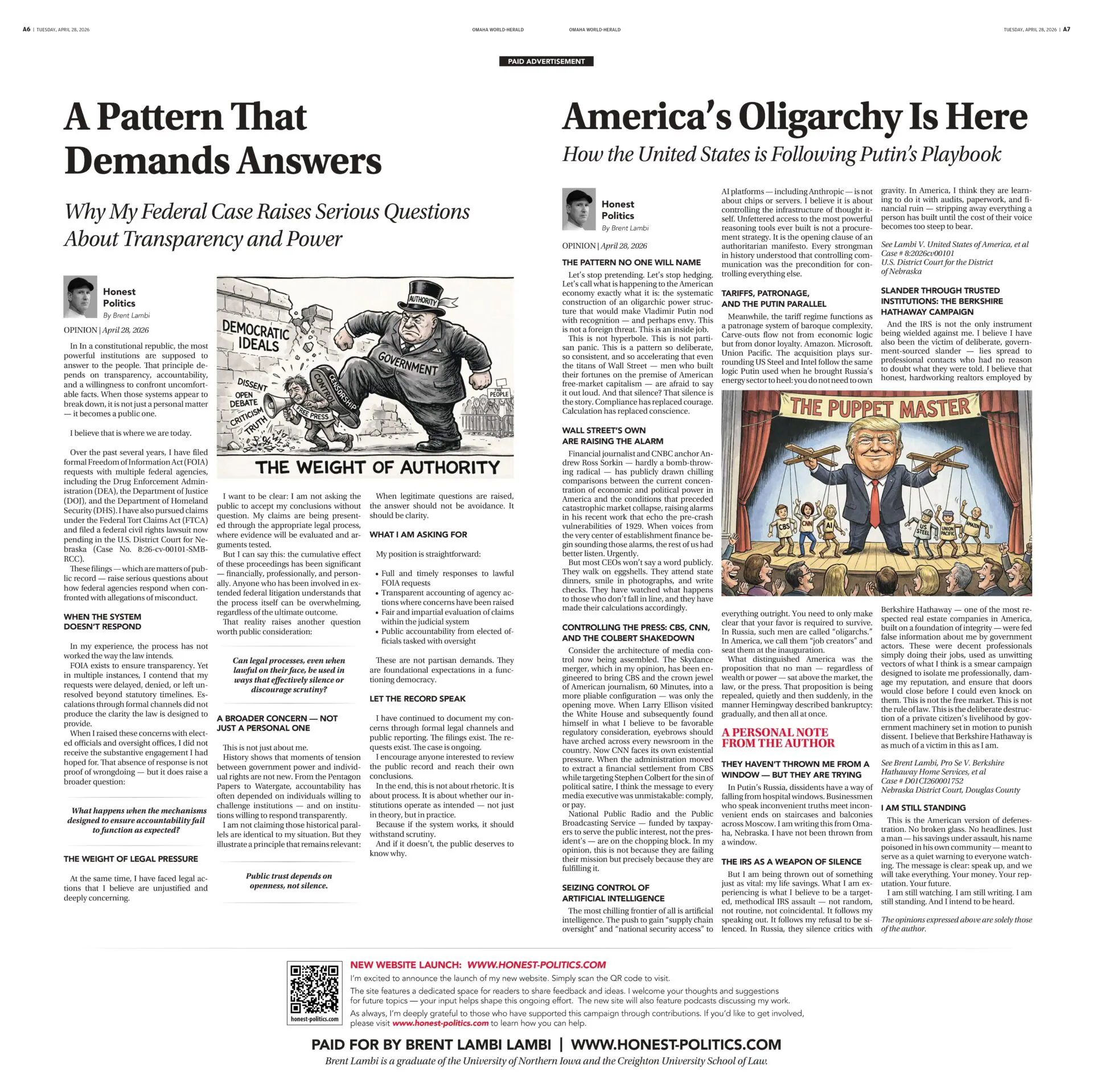
THE PATTERN NO ONE WILL NAME
Let’s stop pretending. Let’s stop hedging.
Let’s callwhat is happening to the American
economy exactly what it is: the systematic
construction of an oligarchic power structure
that would make Vladimir Putin nod
with recognition — and perhaps envy. This
is not a foreign threat. This is an inside job.
This is not hyperbole. This is not partisan
panic. This is a pattern so deliberate,
so consistent, and so accelerating that even
the titans of Wall Street — men who built
their fortunes on the premise of American
free-market capitalism — are afraid to say
it out loud. And that silence? That silence is
the story.Compliance has replaced courage.
Calculation has replaced conscience.
WALL STREET’S OWN
ARE RAISING THE ALARM
Financial journalist andCNBCanchorAndrew
Ross Sorkin — hardly a bomb-throwing
radical — has publicly drawn chilling
comparisons between the current concentration
of economic and political power in
America and the conditions that preceded
catastrophicmarket collapse, raising alarms
in his recent work that echo the pre-crash
vulnerabilities of 1929. When voices from
the very center of establishment finance begin
sounding those alarms, the rest of us had
better listen. Urgently.
But most CEOs won’t say a word publicly.
They walk on eggshells. They attend state
dinners, smile in photographs, and write
checks. They have watched what happens
to those who don’t fall in line, and they have
made their calculations accordingly.
CONTROLLING THE PRESS: CBS, CNN,
AND THE COLBERT SHAKEDOWN
Consider the architecture of media control
now being assembled. The Skydance
merger, which in my opinion, has been engineered
to bring CBS and the crown jewel
of American journalism, 60 Minutes, into a
more pliable configuration — was only the
opening move. When Larry Ellison visited
the White House and subsequently found
himself in what I believe to be favorable
regulatory consideration, eyebrows should
have arched across every newsroom in the
country. Now CNN faces its own existential
pressure. When the administration moved
to extract a financial settlement from CBS
while targeting StephenColbert for the sinof
political satire, I think the message to every
media executivewas unmistakable: comply,
or pay.
National Public Radio and the Public
Broadcasting Service — funded by taxpayers
to serve the public interest, not the president’s
— are on the chopping block. In my
opinion, this is not because they are failing
theirmission but precisely because they are
fulfilling it.
SEIZING CONTROL OF
ARTIFICIAL INTELLIGENCE
The most chilling frontier of all is artificial
intelligence. The push to gain “supply chain
oversight” and “national security access” to
AI platforms—includingAnthropic—is not
Honest
Politics
By Brent Lambi
about chips or servers. I believe it is about
controlling the infrastructure of thought itself.
Unfettered access to the most powerful
reasoning tools ever built is not a procurement
strategy. It is the opening clause of an
authoritarian manifesto. Every strongman
in history understood that controlling communication
was the precondition for controlling
everything else.
TARIFFS, PATRONAGE,
AND THE PUTIN PARALLEL
Meanwhile, the tariff regime functions as
a patronage system of baroque complexity.
Carve-outs flow not from economic logic
but from donor loyalty. Amazon. Microsoft.
Union Pacific. The acquisition plays surrounding
US Steel and Intel follow the same
logic Putin used when he brought Russia’s
energy sector toheel: youdonotneedtoown
everything outright. You need to only make
clear that your favor is required to survive.
In Russia, such men are called “oligarchs.”
In America, we call them“job creators” and
seat themat the inauguration.
What distinguished America was the
proposition that no man — regardless of
wealth or power—sat above themarket, the
law, or the press. That proposition is being
repealed, quietly and then suddenly, in the
manner Hemingway described bankruptcy:
gradually, and then all at once.
A PERSONAL NOTE
FROM THE AUTHOR
THEY HAVEN’T THROWN ME FROM A
WINDOW — BUT THEY ARE TRYING
In Putin’s Russia, dissidents have a way of
falling fromhospitalwindows.Businessmen
who speak inconvenient truthsmeet inconvenient
ends on staircases and balconies
acrossMoscow. I amwriting this fromOmaha,
Nebraska. I have not been thrown from
a window.
THE IRS AS A WEAPON OF SILENCE
But I am being thrown out of something
just as vital: my life savings. What I am experiencing
is what I believe to be a targeted,
methodical IRS assault — not random,
not routine, not coincidental. It follows my
speaking out. It follows my refusal to be silenced.
In Russia, they silence critics with
gravity. In America, I think they are learning
to do it with audits, paperwork, and financial
ruin — stripping away everything a
person has built until the cost of their voice
becomes too steep to bear.
See Lambi V. United States of America, et al
Case # 8:2026cv00101
U.S. District Court for the District
of Nebraska
SLANDER THROUGH TRUSTED
INSTITUTIONS: THE BERKSHIRE
HATHAWAY CAMPAIGN
And the IRS is not the only instrument
being wielded against me. I believe I have
also been the victim of deliberate, government-
sourced slander — lies spread to
professional contacts who had no reason
to doubt what they were told. I believe that
honest, hardworking realtors employed by
Berkshire Hathaway — one of the most respected
real estate companies in America,
built on a foundation of integrity—were fed
false information about me by government
actors. These were decent professionals
simply doing their jobs, used as unwitting
vectors of what I think is a smear campaign
designed to isolate me professionally, damage
my reputation, and ensure that doors
would close before I could even knock on
them. This is not the freemarket. This is not
the rule of law.This is thedeliberatedestruction
of a private citizen’s livelihood by governmentmachinery
set inmotion to punish
dissent. I believe that BerkshireHathaway is
asmuch of a victimin this as I am.
See Brent Lambi, Pro Se V. Berkshire
Hathaway Home Services, et al
Case # D01CI260001752
Nebraska District Court, Douglas County
I AM STILL STANDING
This is the American version of defenestration.
No broken glass. No headlines. Just
aman—his savings under assault, his name
poisoned in his own community—meant to
serve as a quiet warning to everyone watching.
The message is clear: speak up, and we
will take everything. Your money. Your reputation.
Your future.
I am still watching. I am still writing. I am
still standing. And I intend to be heard.