As always, I want to thank all of the readers who have sent messages of support and financial assistance. Please visit my Go Fund Me if you’d like to help me keep this column going.

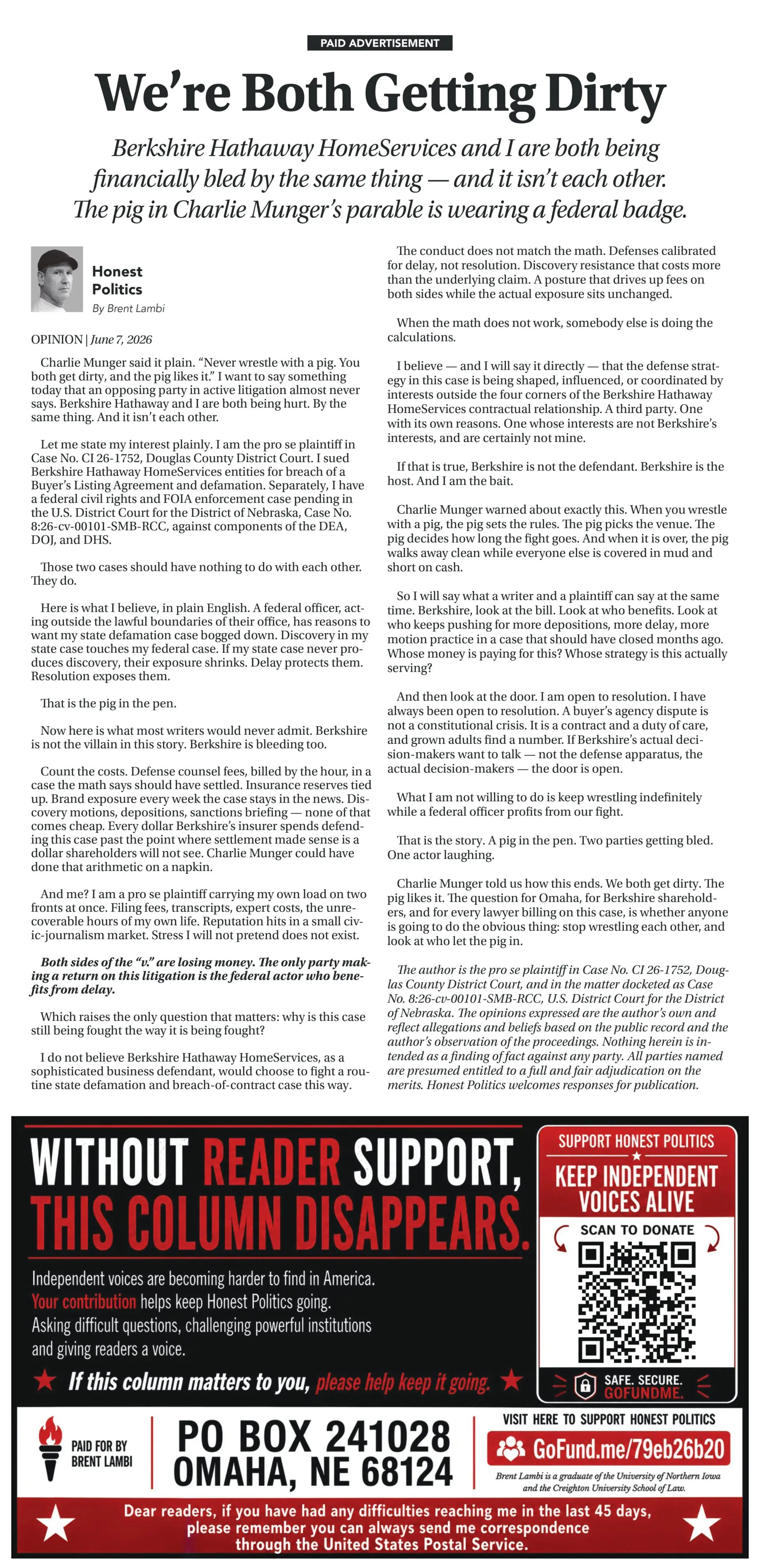
We’re Both Getting Dirty: Berkshire Hathaway HomeServices and I are both being financially bled by the same thing – and it isn’t each other. The pig in Charlie Munger’s parable is wearing a federal badge.

by | Jun 7, 2026 | Political, Uncategorized

Explore More from Brent Lambi

The Tale of Two Carts / The Sickness No Medical School Can Cure / Political Solutions Needed, Not Political Retribution / When the President’s Lawyer Becomes the People’s

The Tale of Two Carts / The Sickness No Medical School Can Cure / Political Solutions Needed, Not Political Retribution / When the President’s Lawyer Becomes the People’s

The Sickness No Medical
School Can Cure
A billion dollars to build healers, while others use
their offices to tear them down.
CHANGE MY MIND
In February 2024, a woman in her nineties stood before a room of medical students in the
Bronx and told them their tuition was gone. Ruth Gottesman had taught at Albert Einstein
College of Medicine since 1968, specializing in learning disabilities, and chaired its board of
trustees. The billion dollars came from her late husband, David, an early investor in Berkshire
Hathaway, who left it to her to spend as she saw fit. She saw fit to make Einstein tuition
free in perpetuity, the largest gift ever made to an American medical school.
Understand what she actually bought. Tuition ran nearly $59,000 a year, and roughly half
of Einstein’s graduates left owing more than $200,000. Debt of that size does not merely burden
a young doctor; it selects her specialty for her. It steers her away from pediatrics, from
primary care, from the clinic in the neighborhood that needs her most and pays her least.
Gottesman did not make doctors rich. She made doctors possible and freed them to study,
to research, and to serve.
“She did not make doctors rich. She made doctors possible.”
Set that beside the spectacle we now call oversight. Anthony Fauci spent five decades on
HIV, Ebola, and COVID and helped build a program credited with saving millions of lives
abroad. His reward in 2026 was a subpoena and a hearing room designed to produce a referral
rather than an answer.
One American spent a fortune expanding the nation’s capacity to heal. Others use their
offices, their subpoena power, and our money to attack the people who already did.
That is the contrast worth amplifying. A gift like Gottesman’s is not charity; it is infrastructure.
It will outlive every politician currently auditioning outrage for a fundraising list.
Medical school can teach anatomy. It cannot teach gratitude. It can teach pharmacology,
but there is no course in humility, and no prescription for a public official who mistakes
destruction for duty. That sickness is moral, not clinical, and the only known treatment is
administered at the ballot box.
“It could probably be shown by facts and figures that there is no
distinctly native American criminal class except Congress.”
MARK TWAIN, Following the Equator (1897),
Pudd’nhead Wilson’s New Calendar The Tale of Two Carts
You work to fill yours. The President plays beside his.
ON AFFORDABILITY, PRIORITIES,
AND WHO SENDS THE INVOICE
Fifty-two weeks a year, Americans push a steel cart down an aisle and do arithmetic.
Ground beef runs about $6.75 a pound. Fresh vegetables are up 11.9 percent, tomatoes 32
percent, and lettuce nearly 25 percent. Groceries cost roughly 30 percent more than they did
before the pandemic. Households drop the roast, buy the chicken, and move on.
Notice what fills that cart. A shift. A double. Overtime that was supposed to go toward the
truck payment. Every item in it was purchased with somebody’s hours, hours traded away
and never returned. That is the honest arrangement most Americans live under: you work,
and then you eat.
THE PRESIDENT’S CARTS ARE PROCURED.
The ledger: $765,425 in Secret Service golf-cart rentals during his first term. $95,250 for a
single Bedminster season in 2019. Then, on June 3, 2025, came a contract with Associates Golf
Car Service worth up to $550,930, plus $80,385 for portable toilets, renewable to $333,801.
Behind him rolls “Golf Force One,” an armored Polaris Ranger that the General Services
Administration prices near $190,000. The unarmored version sells for about $20,000.
And in 2018, his own Turnberry resort billed the taxpayers $923 to rent carts to the agents
guarding him.
The larger tab: $151.5 million in term one. Nearly $115 million already in term two, on pace
for $300 million, with 112 days on his own courses, more than a quarter of his days in office.
“One cart is filled by labor.
The other is followed by an armored escort at $190,000 a copy.”
WHAT THIS IS NOT ABOUT
It is not about security. Agents must protect the President, and after two attempts on his
life, one of them on a golf course, the hardware is defensible on its face. That duty is not optional,
and this page will not pretend otherwise.
It is about venue and profit. He chooses to be protected at properties he owns, which
means the government rents, hauls, and staffs its way onto his balance sheet. Every fairway
is a cost center billed to people counting coupons at the register.
THE ARITHMETIC OF IT
A family that overspends on groceries eats less. A President who overspends on golf carts
sends the invoice to the family. One cart is earned. The other is expensed.
So ask your candidate, in public and on the record, to defend the invoice. Not the man.
The invoice. Political Solutions Needed,
Not Political Retribution
An endorsement used to be a recommendation.
It has become a loyalty oath.
There was a time when a party’s backing meant a candidate had been measured for
judgment, competence, and the ability to fix something. That standard is gone. Today the
“MAGA” or “Trump” endorsement certifies exactly one qualification: obedience. In my
opinion, it is a badge of dishonor, and a vote cast for it is a vote to enable conduct that in any
other American workplace would end a career.
Look at what the endorsement now guarantees. Not a health care plan. Not a budget. Not
a border solution written into law rather than announced from a podium. What it guarantees
is a candidate who will call every Democrat a communist, blame a predecessor who left
office years ago, insult a reporter, and go home having solved nothing. The vocabulary is
retribution. The vocabulary of governing, including appropriation, oversight, compromise,
and arithmetic, has been discarded as weakness.
This is not conservatism. Conservatism had a fiscal argument. It had a federalism argument.
It produced people who could read a balance sheet. What replaced it is a class of political
opportunists with no measurable ability, promoted for volume rather than skill, who
mistake grievance for a platform and cruelty for courage.
“A man who can only name an enemy is telling
you he cannot name a solution.”
And the tarnish runs from the top down. A convicted felon sits atop the ticket, and men
and women who once claimed to revere the rule of law now defend, excuse, and pardon on
command. Silence inside that line is not neutrality. It is participation. When you stand in a
party’s column, you accept its implied association, and you own what is done in your name.
I do not ask any reader to become a Democrat. I have never been one. I ask something
harder: demand a solution before you surrender a vote. Ask what they will build, not who
they will punish. Ask for the bill number. Ask for the math.
Retribution is not a policy. It is an admission that you have none. When the President’s Lawyer
Becomes the People’s
The Senate Judiciary Committee has sent Todd Blanche to the
floor. The only question left is whether fifty senators will pretend
the conflict of interest isn’t there.
The Senate Judiciary Committee voted 12-10 Tuesday to advance Todd Blanche, Donald
Trump’s personal criminal defense attorney, toward confirmation as Attorney General.
Read that again. The man who sat beside the defendant is to become the lawyer for all of us.
Every first-year law student learns to avoid even the appearance of impropriety. What
Blanche has assembled is not an appearance. As acting Attorney General, he signed the
order declaring the IRS “forever barred” from pursuing prior tax claims against his former
client, that client’s family, and that client’s companies, resolving a $10 billion suit Trump
filed against his own government, in which Blanche’s Justice Department was nominally
the opposing party. A federal judge questioned whether the case had two genuine sides. It
didn’t. It had one man on both.
Then came the “Anti-Weaponization Fund”: $1.776 billion in Treasury money, overseen
by a board the acting Attorney General himself would appoint, to pay those who felt persecuted
by their government. Pardoned January 6 rioters were among the potential claimants.
“A nominee purchased his confirmation by giving back money
he should never have reached for, and the Senate accepted
the refund as a character reference.”
Facing lost votes, Blanche rescinded the fund Sunday night. Senators Cornyn and Tillis,
both leaving Congress and both driven out by Trump, pronounced themselves satisfied
and voted yes. Grasp that. A nominee purchased his confirmation by giving back money he
should never have reached for, and the Senate accepted the refund as a character reference.
Trump says he would revive it if Blanche is blocked. The audit shield remains. Scholars warn
that a later order could resurrect the fund overnight.
The obscenity is not the amendment. It is that one was needed at all. A serious chamber
haggled over the price instead of rejecting the nomination outright.
TWO REMEDIES, BOTH HELD BY CITIZENS
Citizens hold two remedies. Keep the roll call. Every senator who votes yes owns this, and
elections exist for exactly that. Ask them at town halls whether the Attorney General serves
the country or the client.
Then write the New York bar. Blanche’s license came from a state, not from Donald
Trump. Ask the grievance committee whether a lawyer may hand his client a federal absolution
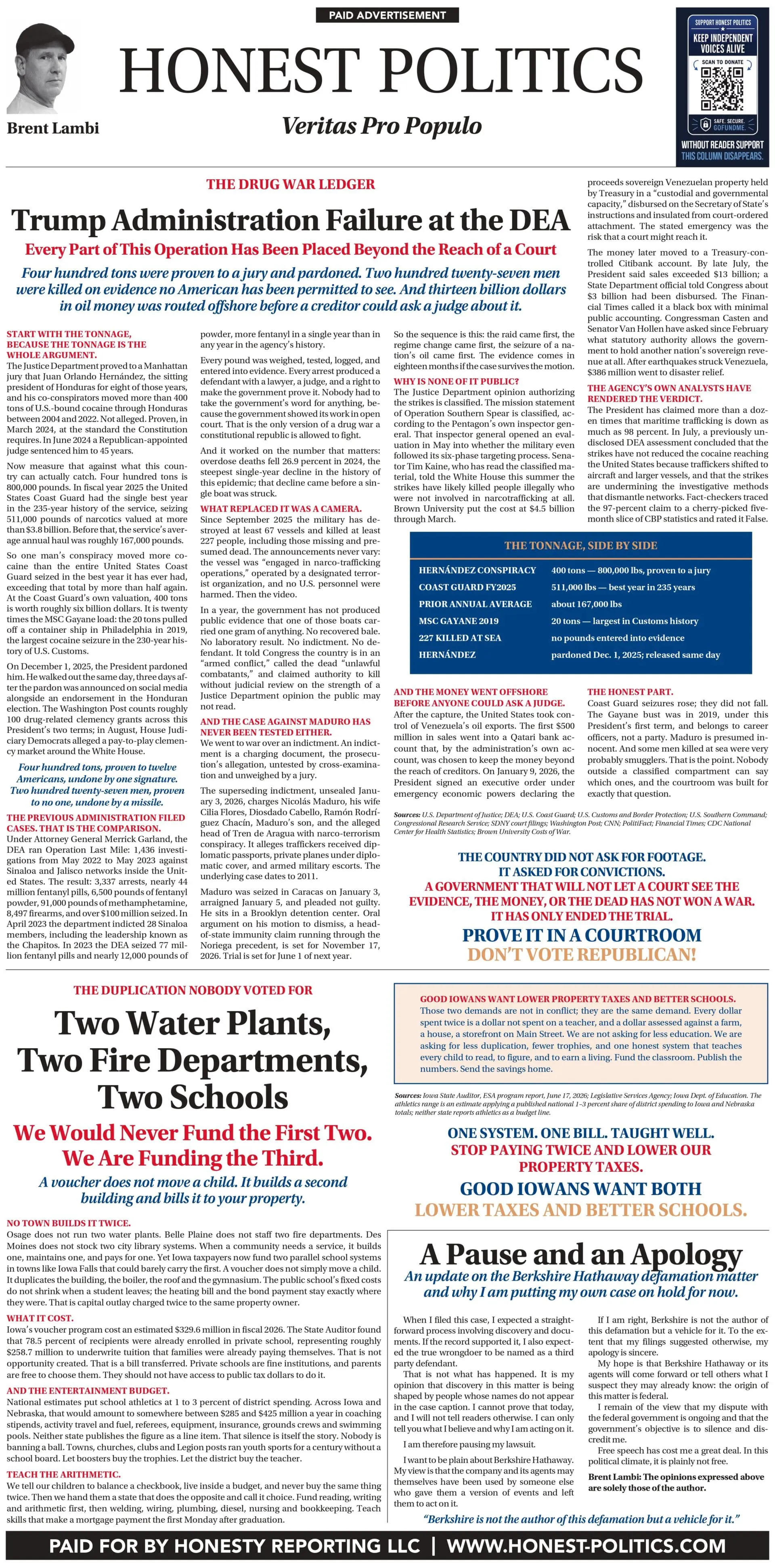
paid out of the Treasury, and whether that license should survive the answer. A Pause and an Apology
An update on the Berkshire Hathaway defamation matter
and why I am putting my own case on hold for now.
When I filed this case, I expected a straightforward process involving discovery and documents.
If the record supported it, I also expected the true wrongdoer to be named as a third
party defendant.
That is not what has happened. It is my opinion that discovery in this matter is being
shaped by people whose names do not appear in the case caption. I cannot prove that today,
and I will not tell readers otherwise. I can only tell you what I believe and why I am acting on it.
I am therefore pausing my lawsuit.
I want to be plain about Berkshire Hathaway. My view is that the company and its agents
may themselves have been used by someone else who gave them a version of events and left
them to act on it.
“Berkshire is not the author of this defamation but a vehicle for it.”
If I am right, Berkshire is not the author of this defamation but a vehicle for it. To the extent
that my filings suggested otherwise, my apology is sincere.
My hope is that Berkshire Hathaway or its agents will come forward or tell others what I
suspect they may already know: the origin of this matter is federal.
I remain of the view that my dispute with the federal government is ongoing and that the
government’s objective is to silence and discredit me.
Free speech has cost me a great deal. In this political climate, it is plainly not free.
Brent Lambi
The opinions expressed above are solely those of the author.

read more
The Compliment You Didn’t Ask For / The Sickness No Medical School Can Cure / The Strait is Not The Border / What the Pool Reflects

The Compliment You Didn’t Ask For / The Sickness No Medical School Can Cure / The Strait is Not The Border / What the Pool Reflects

HONEST POLITICS
Brent Lambi
The Strait is Not The Border
Forty thousand people looked at the world as it is and
decided to swim. The rest of us should ask what they were
swimming away from and who built it.
Last week, tens of thousands of young Moroccans walked into the sea. French reporting
put the figure near 40,000; Ceuta’s own leader estimated 60,000, with Madrid counting roughly
8,000 children among them. They swam around a breakwater toward a beach in Africa that
happens to belong to Spain. Dozens drowned doing it.
Ask why, honestly. The answer is not recklessness. It is arithmetic. From Fnideq, a young
man can see, five kilometers across open water, a life he cannot reach in forty years of labor
on his own side. He priced the swim against the wait and took the swim. Meanwhile, Ukrainians
die defending a border, Gazans die trapped inside one, and half the world lives beyond
the reach of a physician.
He priced the swim against the wait and took the swim.
We are told some nations simply do things right. Norway educates its children, insures its
sick, and pensions its elderly. But Norway also sits atop North Sea oil and had the rare discipline
to bank the proceeds for the unborn instead of spending them on itself. Afghanistan
has been an empire’s chessboard for a century and a half, with British, Soviet, and American
powers each arriving with a theory and departing with a body count. Institutions matter
enormously. So does whether the world ever permitted you to build any.
That distinction should trouble us, because it decides who gets to be born lucky.
So here are the questions we should ask aloud and answer on the record:
If prosperity is largely an accident of geology, geography, and who invaded whom, on what
moral ground do we call it earned?
Is a border a legitimate line of governance, or a fence around a lifeboat?
We spent $113 billion on 145 days of war in Iran. What would that sum have purchased in
clinics, wells, and classrooms, and which purchase would have produced fewer swimmers?
If a stranger’s child drowns within sight of your shore, does distance excuse you, or only
comfort you?
And the hardest one: do we hold these gifts in trust, or in fee simple?
A man born on the lucky side of the water will tell you
it was his swimming that got him there.
The Compliment You Didn’t Ask For
On being diagnosed by people who have never opened a chart
Congratulations. You have been diagnosed.
Not by a physician, not after an examination, and not on the basis of anything you actually
said. You were diagnosed the instant you produced a fact your opponent could not answer.
The condition is called Trump Derangement Syndrome, and the only known symptom is
winning.
Consider how the diagnosis is made. You cite a dollar figure. You cite a court ruling. You
ask a question with a documentary answer. Your opponent, finding no fact of his own, reaches
past the argument and reaches for you. He does not say the number is wrong. He says you
are unwell.
In debate, this maneuver has a name older than the republic. It is the ad hominem, and it
is not a rebuttal but a surrender delivered in the tone of an insult. A man with better evidence
produces the evidence. A man without it produces a label. When the label arrives, the scoring
is over; only the volume is still in dispute.
A man with better evidence produces the evidence.
A man without it produces a label.
Notice what the phrase concedes. To call criticism deranged is to admit that criticism exists
in quantity and that ordinary people, given the record, keep arriving at the same unflattering
conclusion. That is not a syndrome. That is a consensus.
Honesty requires a word for the other side. Some criticism is unhinged. There are people
who read a grocery receipt as a coup and who would be no better company under any other
president. Say so when you see it. But the cure for a bad argument is a better one, not a nickname,
and the man who cannot tell the difference has told you which he lacks.
So accept the honor. When someone informs you that you are deranged, he has told you
three things: he heard you, he could not answer you, and he would rather discuss your mind
than his candidate’s record.
Take the trophy. It was awarded under protest, which is the only kind worth having.
The Sickness No Medical
School Can Cure
A billion dollars to build healers, while others use
their offices to tear them down
CHANGE MY MIND
In February 2024, a woman in her nineties stood before a room of medical students in the
Bronx and told them their tuition was gone. Ruth Gottesman had taught at Albert Einstein
College of Medicine since 1968, specializing in learning disabilities, and chaired its board of
trustees. The billion dollars came from her late husband, David, an early investor in Berkshire
Hathaway, who left it to her to spend as she saw fit. She saw fit to make Einstein tuition
free in perpetuity, the largest gift ever made to an American medical school.
Understand what she actually bought. Tuition ran nearly $59,000 a year, and roughly half
of Einstein’s graduates left owing more than $200,000. Debt of that size does not merely burden
a young doctor; it selects her specialty for her. It steers her away from pediatrics, from
primary care, from the clinic in the neighborhood that needs her most and pays her least.
Gottesman did not make doctors rich. She made doctors possible and freed them to study,
to research, and to serve.
“She did not make doctors rich. She made doctors possible.”
Set that beside the spectacle we now call oversight. Anthony Fauci spent five decades on
HIV, Ebola, and COVID and helped build a program credited with saving millions of lives
abroad. His reward in 2026 was a subpoena and a hearing room designed to produce a referral
rather than an answer.
One American spent a fortune expanding the nation’s capacity to heal. Others use their
offices, their subpoena power, and our money to attack the people who already did.
That is the contrast worth amplifying. A gift like Gottesman’s is not charity; it is infrastructure.
It will outlive every politician currently auditioning outrage for a fundraising list.
Medical school can teach anatomy. It cannot teach gratitude. It can teach pharmacology,
but there is no course in humility, and no prescription for a public official who mistakes
destruction for duty. That sickness is moral, not clinical, and the only known treatment is
administered at the ballot box.
“It could probably be shown by facts and figures that there is no
distinctly native American criminal class except Congress.”
MARK TWAIN, Following the Equator (1897),
Pudd’nhead Wilson’s New Calendar
What the Pool Reflects
Sixteen million dollars, a friend with a contract awarded without
bidding, and a mirror the President refuses to look into.
“Nothing so needs reforming as other people’s habits.”
Mark Twain, Pudd’nhead Wilson’s Calendar (1894)
A reflecting pool has exactly one job. It shows you what is standing in front of it.
For roughly $16 million of the public’s money, the Lincoln Memorial Reflecting Pool
has performed that job with a fidelity no one in this administration intended. It reflected a
rushed vanity project. It reflected a contract handed to a friend. It reflected a government
that, confronted with its own failure, went looking for a citizen to punish.
THE MONEY
A $14.7 million contract awarded without competitive bidding went to Atlantic Industrial
Coatings of Virginia to spread blue waterproofing across the pool’s concrete floor, justified
by urgent need. The Park Service bypassed competitive bidding by invoking an urgency exemption
tied to the nation’s 250th anniversary. A second contract, worth $1.7 million, went
to Green Water Solutions, an Ohio firm whose owner keeps a home in Palm Beach less than a
mile from the President’s Palm Beach residence. Its controlling figure, John J. Cafaro, has two
felony convictions: a 2001 guilty plea for conspiring to bribe a congressman and a 2010 plea
for a campaign finance violation. A deadline became a license. The license became a favor.
The work failed within days. The coating peeled. The water turned green. And the President
of the United States went on social media to announce, without evidence, that saboteurs had
cut a gash measuring 250 feet into the facade and poured corrosive chemicals into the water.
THE BLAME
Then came the arrests. A person who was 17 years old was cited over a piece of paint. And
David “Davey” Hearn, who competed in the Olympics three times, was indicted on a felony
charge carrying a sentence of up to ten years, accused of pulling up roughly two square feet
of liner. The U.S. Attorney announced “tremendous evidence.”
On July 31, that case collapsed. Prosecutors told the court the damage resulted from
flawed installation by the contractor, not vandalism. More damningly, they said that if the
Interior Department had been forthcoming with information already in its possession, no
indictment would ever have been sought.
A man who cannot look at a mirror without
demanding it show him someone else.
Credit where it is owed: Jeanine Pirro corrected the record against her own interest. Days
earlier, the Interior secretary had told the country the contractor did a fantastic job and would
be rehired for the repairs. And the President? On Saturday he answered the confession of his
own Justice Department by insisting the major damage was still the work of vandals.
WHAT HISTORY RECORDS
Here is the part worth remembering. History reflects well on the public servant who owns
a mistake. It always has. Voters forgive error; they do not forgive the official who insists the
mirror is lying. Pirro will be remembered for the harder filing, not the easier one. An honest
correction is not weakness; it is the whole reason an office is worth holding.
An Olympian’s name was put on a federal felony indictment to cover a contractor’s failure.
That is not a paint problem. That is the machinery of federal prosecution turned into a
drop cloth.
THE RIPPLE
“We are discreet sheep; we wait to see how the drove is going,
and then go with the drove.” Twain wrote that of the American
habit of borrowing an opinion rather than forming one.
But a reflecting pool does more than mirror. It ripples. Whatever is thrown into it travels
outward to the edges, which is to say, to us. A political party is an implied association. When
a voter stands inside a party line and says nothing about a contract awarded without bidding
and steered to a neighbor, or an innocent citizen charged to protect an official story, that
silence becomes part of the reflection. It is not only the President in that water. It is everyone
standing behind him who declined to speak.
Congress has the bidding under review. Voters hold something stronger: a ballot and the
standing to demand honesty before they spend it. Demand it out loud and demand it of your
own side first. History reflects favorably on those who did and keeps a clear record of those
who did not.

read more
Your Ballot Is Not Local / Both Hands On The Scale / Name Calling Is Not a Denial / The Crazed Librarian / A PERSONAL NOTE FROM THE AUTHOR

Your Ballot Is Not Local / Both Hands On The Scale / Name Calling Is Not a Denial / The Crazed Librarian / A PERSONAL NOTE FROM THE AUTHOR

Your Ballot Is Not Local
A ballot cast at the county line is spent in Washington and in every capital watching how we answer.
There is no longer any such thing as a purely local vote.
A county commissioner, legislator, or school board member running on the MAGA line is not an isolated figure. That candidate is a precinct in a national machine. The candidate’s margin is reported as a mandate. Party leadership reads the win as permission. What the candidate ratifies at home is executed in Washington and exported to the rest of the world.
To shrug at either is to choose the predator over the prey.
So put two questions to that candidate and write down the answers.
Will you demand the complete, unredacted release of the Epstein files? Congress already answered: the Epstein Files Transparency Act passed overwhelmingly and set a December 19 deadline. Seven months later, a federal judge was still ordering the Department to unredact records or explain itself. Among those records was a draft indictment with the names of potential accomplices blacked out. Redaction shields victims. Nothing in that statute authorized the Department to shield names.
Will you condemn the pardon of Juan Orlando Hernández? A federal jury convicted him; a judge sentenced him to 45 years for a scheme that moved more than 400 tons of cocaine into this country, the equivalent of some 4.5 billion doses, while he boasted he would stuff the drugs up the gringos’ noses. The President erased the punishment in a social media post. This month he returned home to cheers in Tegucigalpa.
I state this as my opinion, and I mean it plainly. A candidate who will not answer those two questions stands on the same moral ground as someone who knows what was done to a child and keeps it secret. The files are records of children sold to powerful men. The pardon freed a trafficker who poisoned somebody’s sons and daughters by the ton. To shrug at either is to choose the predator over the prey. I would not leave a child in such a person’s care. I do not intend to leave a county, a state, or a country there either.
Your ballot does not stop at the county line. Cast locally, it is spent nationally and globally: in a Justice Department that treats a deadline as a suggestion, in a pardon power operated as a favor bank for the convicted and connected, and in every capital now reading American law as negotiable.
Ask them at the forum. Ask them on the doorstep. Then vote as though the answer will be enforced in your name, because it will be.
Name Calling Is Not a Denial
The President answers questions about Epstein with a label.
A label is not an answer.
Ask the President why the Epstein files remain sealed and redacted, and you will not get an answer. You will get a diagnosis.
In Michigan on July 27, a man in the crowd accused him of protecting pedophiles. Mr. Trump did not rebut the charge. He waited for security, pointed into the audience, and pronounced the man a communist. He then pivoted to a riff about seized houses and tax rates of 80 percent. The accusation went unanswered. The crowd got a villain instead.
This is the whole method. Demand transparency from the left and you are a communist. Demand it from the right, as Marjorie Taylor Greene did, and you are branded a traitor. Demand it in print and the entire matter becomes a hoax perpetrated by Democrats. The label performs the work the evidence cannot.
“The faithful execution of the laws is not a left-wing hobby.”
Consider what is being called communism here: the belief that the Epstein Files Transparency Act, a law the President himself signed, ought to be obeyed. That is not Marx. That is Article II. The faithful execution of the laws is not reserved for the political left, and insisting upon it is not a symptom requiring treatment.
Note, too, who gets pathologized. Not the trafficker. Not the men in the flight logs. The citizen asking the question.
A man with nothing to hide answers questions. A man with something to hide changes the subject and then insults whoever noticed. We have now watched both.
Release the files. Unredacted. Then call us whatever you like.
A SATIRE ON THE STEWARDSHIP OF PUBLIC INSTITUTIONS
The Crazed Librarian
A public collection is a trust, not a private shelf, and the clerk at the desk is not the author.
Imagine a librarian who wakes one morning having forgotten that he does not own the library.
The books were bought with the public’s money. The building was raised by the public’s hand. His only job is to keep the doors open, the shelves stocked, and the card catalog honest, so that every citizen who walks in may find what is there and judge it for himself. Instead, our librarian arrives with a red pen, a stepladder, and a nameplate.
First, the pen. The Smithsonian, that great national reading room, has been directed to hand over its wall placards, its exhibition catalogs, its internal guidelines, and its plans through 2029, so that “divisive” language may be replaced with something more “unifying,” as though the American past were a customer complaint to be managed. At the Kennedy Center, the board was cleared and restocked with loyalists. Programming vanished. Artists walked. This is not curation. This is a librarian rewriting the endings he dislikes and shelving the rest in the basement.
“One tradition endows. The other edits.”
Second, the ladder. Andrew Carnegie funded some 2,500 libraries, put his name on the masonry, and then handed the collections to the towns that used them. Set that beside the Moscow model of librarianship, where the catalog is revised to match the man behind the desk and yesterday’s authors are quietly erased. One tradition endows. The other edits.
Third, the nameplate. Dulles. Penn Station, its name reportedly dangled in exchange for sixteen billion dollars in frozen tunnel money. The Institute of Peace, rebranded. The Kennedy Center itself was renamed in December, but a federal judge barred the change in May, and workmen scraped off the letters in June. A national park pass bearing the President’s face beside Washington’s. A House committee voting 33 to 25 to name the Opera House for the First Lady. Somewhere, a bill waits to make an international airport a monogram.
Fourth, the tote bag. A rule so obvious that it was never written down: what the library buys or produces while the librarian is employed does not follow him home when he retires. It is not his to box up and shelve beside a bathtub for late reading. The collection stays. The clerk leaves.
A librarian who stamps his name across every spine has confused stewardship with ownership. The remedy is old and unglamorous: he is not the author, not the publisher, not the owner. He is the temporary clerk on duty.
The books belong to us. Every one of them. Including the ones he would rather we did not read.
A PERSONAL NOTE FROM THE AUTHOR
THEY HAVEN’T THROWN ME FROM A WINDOW – BUT THEY ARE TRYING
In Putin’s Russia, dissidents have a way of falling from hospital windows. Businessmen who speak inconvenient truths meet inconvenient ends on staircases and balconies across Moscow.
I am writing this from Omaha, Nebraska. I have not been thrown from a window.
THE IRS AS A WEAPON OF SILENCE
But I am being thrown out of something just as vital: my life savings. What I am experiencing is what I believe to be a targeted, methodical IRS assault. Not random, not routine, not coincidental. It follows my speaking out. It follows my refusal to be silenced. In Russia, they silence critics with gravity. In America, I think they are learning to do it with audits, paperwork, and financial ruin. Stripping away everything a person has built until the cost of their voice becomes too steep to bear.
See Lambi v. United States of America, et al Case # 8:2026cv00101U.S. District Court for the District of Nebraska
SLANDER THROUGH TRUSTED INSTITUTIONS: THE BERKSHIRE HATHAWAY CAMPAIGN
And the IRS is not the only instrument being wielded against me. I believe I have also been the victim of deliberate, government-sourced slander and lies spread to professional contacts who had no reason to doubt what they were told. I believe that honest, hardworking realtors employed by Berkshire Hathaway, one of the most respected real estate companies in America built on a foundation of integrity, were fed false information about me by government actors. These were decent professionals simply doing their jobs, used as unwitting vectors of what I think is a smear campaign designed to isolate me professionally, damage my reputation, and ensure that doors would close before I could even knock on them. This is not the free market. This is not the rule of law. This is the deliberate destruction of a private citizen’s livelihood by government machinery set in motion to punish dissent. I believe that Berkshire Hathaway is as much of a victim in this as I am.
See Brent Lambi, Pro Se V. Berkshire Hathaway Home Services, et al Case
# DO1CI260001752Nebraska District Court, Douglas County
I AM STILL STANDING
This is the American version of defenestration. No broken glass. No headlines. Just a man with his savings under assault, his name poisoned in his own community meant to serve as a quiet warning to everyone watching. The message is clear: speak up, and we will take everything. Your money. Your reputation. Your future.
I am still watching. I am still writing. I am still standing. And I intend to be heard.
The opinions expressed above are solely those of the author.
Both Hands On The Scale
They came for the lawyers. Then they came for the newsroom that reported it.
Two things protect an ordinary person from a government determined to have its way: a lawyer willing to take an unpopular case and a reporter willing to publish an unwelcome fact. Both were squeezed quietly through paperwork.
Start with the lawyers. The White House signed orders against Perkins Coie, Jenner & Block, WilmerHale, and Susman Godfrey, stripping security clearances, canceling government contracts, and barring their attorneys from federal buildings. In plain terms, you cannot get in the door, and your clients are punished for hiring you. A judge found that the firms were chosen for the causes they champion and the clients they represent. Four federal judges ruled the orders unconstitutional; the government dropped its appeals. Nine other firms never fought. Instead, they pledged hundreds of millions in free legal work to avoid being named. Protection money.
The courts said no. So the pressure moved to the institution that still tells the public what happened.
60 Minutes reported that campaign against the law firms. Scott Pelley won a Cronkite Award for that very coverage. Meanwhile, the President was suing CBS for $20 billion over an interview edit, while CBS’s parent needed federal approval for an $8 billion merger. Picture the person suing you while also holding the permit you need to stay open. Paramount paid $16 million. The merger cleared.
Now follow the chain. The new owner installed Bari Weiss atop CBS News. Weiss fired the show’s executive producer, three senior producers, and correspondents Sharyn Alfonsi and Cecilia Vega, and then installed Nick Bilton, a technology journalist with no traditional broadcast news experience. On June 2, Pelley was fired too, a day after reportedly telling staff that Weiss was “murdering the show.” A finished segment on an El Salvador prison had already been pulled. Three correspondents remain.
No law was passed. No vote was taken. Clearances, contracts, a merger review, and a personnel file did the work.
Silence the lawyer and the case is never filed. Buy the network and the silencing is never reported.
That is not a policy dispute. That is the removal of both witnesses.
So put these questions to every Republican or MAGA candidate on your ballot, on the record:
ONE. Four federal judges ruled these orders against law firms unconstitutional. Do you agree with those rulings: yes or no?
TWO. Should a federal license, contract, or merger approval ever depend on how a network covers the President: yes or no?
And if a candidate will not answer either question, ask plainly: why are you against the rule of law and the First Amendment?
Silence is an answer. In my opinion, it is the wrong one, and it belongs on the ballot beside the candidate’s name.

read more