by Brent Lambi | Dec 28, 2025 | Political
New Year’s Editorial:
The Happiest Nations Aren’t Drunk on Credit
As the calendar flips and Americans raise a glass to “new beginnings,” a sobering truth sits ignored at the end of the bar: the happiest nations
on Earth did not get there by maxing out their credit cards, refinancing their homes like ATM machines, or gambling their futures on speculative
bubbles dressed up as innovation. They got there through discipline — personal and governmental — through restraint, and through a collective
understanding that prosperity without stability is an illusion.
The Top 5 Happiest Nations
and Why They’re Not Miserable About Money
Year after year, global happiness and life-satisfaction rankings tell the same story. The most content populations tend to live in countries that
practice boring, unglamorous, fiscally responsible habits:
Finland – High trust in institutions, low corruption, strong social safety nets, and modest consumer debt.
Denmark – Balanced budgets, high wages, low inequality, and citizens who don’t confuse happiness with consumption.
Iceland – Hard lessons learned after financial collapse, followed by reform — not denial.
Sweden – Long-term investment in people, not short-term political sugar highs.
Norway – The gold standard of fiscal adulthood.
These countries enjoy high consumer confidence not because credit is cheap, but because life is predictable, institutions are trusted, and the
future does not feel like a financial ambush waiting to happen.
Norway vs. America: A Tale of Two Futures
Norway sits atop a sovereign wealth fund worth well over a trillion dollars, built from oil revenues explicitly saved for future generations.
It is a nation that asked a radical question: What if we didn’t spend everything today and leave our children the bill?
America asked the opposite.
The United States, blessed with unmatched resources, innovation, and talent, has instead chosen permanent deficit spending, serial debt
ceiling theater, and a political culture addicted to postponing pain. Record government debt is no longer treated as an emergency — it’s treated
as background noise.
America’s Credit Addiction
The American household balance sheet tells a tragic, circular story:
• Refinance the home because interest rates are low
• Use home equity for vacations, cars, or lifestyle upgrades
• Pay off maxed-out credit cards
• Credit limits increase
• Spend again
• Repeat
This is not wealth creation. This is financial musical chairs — and when the music stops, someone is left standing with
negative equity and no seat.
Consumer confidence in America is fragile because it is artificial. It is built on teaser rates, minimum payments, and the
comforting lie that tomorrow will always bail out today’s excess.
Crypto: The Slot Machine With a White Paper
And then there is cryptocurrency — sold as rebellion, freedom, and the future, but often behaving like a casino floor with
better branding. Prices rise not on cash flow, productivity, or long-term utility, but on momentum and belief. Just like
musical chairs, it works beautifully — until it doesn’t.
Speculation is not a retirement plan. Volatility is not innovation. And hope is not a balance sheet.
Why Happier Nations Sleep Better
The happiest countries are not obsessed with:
• Constantly rising home prices
• Ever-lower interest rates
• Endless consumption as a substitute for meaning
They live in smaller homes, carry less personal debt, accept higher taxes in exchange for stability, and understand that
security is the foundation of happiness — not leverage.
A New Year’s Warning
America does not lack money. It lacks discipline.
• A nation addicted to easy credit eventually faces a brutal hangover: rising rates, falling asset prices, shrinking options,
and shattered confidence. History is clear on this point. Empires do not collapse from a lack of wealth — they collapse
from pretending debts don’t matter.
• As the New Year begins, the happiest nations quietly keep their books balanced and their futures funded. America,
meanwhile, keeps ordering another round — convinced the bill will never arrive.
• It always does.
Norway plans for grandchildren.
America refinances for spring br
by Brent Lambi | Dec 21, 2025 | Political
Christmas, Christ, and the Failure of “Big People”
Every Christmas, the powerful wrap themselves in
the language of faith while governing in ways that
mock it.
Nativity scenes are displayed. Carols echo through
marble halls. Bibles are lifted for cameras. Yet across
the world—and within our own borders—millions of
God’s children go without healthcare, food, or shelter,
while a privileged few are rewarded with private
airplanes, gold toilets, multiple mansions, and
fortunes too large to count.
This is not Christianity. It is spectacle.
Jesus Christ was not born among the rich or the
comfortable.
“She gave birth to her firstborn son… and
placed him in a manger, because there was
no room for them in the inn.”
— Luke 2:7
A small manger, yet big ethical ramifications that
still judge the powerful today.
God Has No “Garbage People”
In too many capitals—Washington included—
people are ranked as worthy or unworthy. The poor
are dismissed. The sick are blamed. Refugees are
dehumanized. Entire populations are treated as
expendable.
But Scripture is unequivocal:
“So God created mankind in His own
image.”
— Genesis 1:27
There are no “garbage people” in God’s eyes. No
disposable lives. No surplus humanity.
Jesus Himself erased every hierarchy of human value:
“Whatever you did for one of the least of
these brothers and sisters of mine, you
did for me.”
— Matthew 25:40
When the poor are denied food, when the sick die
without care, when families sleep without shelter,
Christ is the one being rejected.
A World of Excess Beside a World of Suffering
While some nations lack basic healthcare, while
children starve and elders die untreated, others
accumulate obscene luxuries—private jets, gold-plated
bathrooms, third and fourth homes—wealth locked
away by the few while the many suffer.
Scripture does not bless this imbalance. It condemns
it.
“Woe to you who add house to house
and join field to field until no space is left.”
— Isaiah 5:8
And again:
“You have hoarded wealth in the last
days…The wages you failed to pay the
workers cry out against you.”
— James 5:3–4
This is not success. It is moral failure.
Power Without Mercy Is Not Christian
Jesus never praised wealth without compassion or
power without restraint.
“Blessed are the merciful, for they will be
shown mercy.”
— Matthew 5:7
Leadership in Christ’s name demands humility, not
domination.
“The rulers of the Gentiles lord it over them…
Not so with you.”
— Matthew 20:25–26
Any system that rewards excess while tolerating
misery stands in direct opposition to the Gospel.
Faith Is Not a Photo Op
Perhaps nothing better symbolizes the spiritual
collapse of modern leadership than the use of the
Bible as a political prop—held aloft for attention
while its teachings are ignored.
“These people honor me with their lips, but
their hearts are far from me.”
— Matthew 15:8
Jesus reserved His harshest words for religious
hypocrites who used faith to elevate themselves:
“Woe to you… you clean the outside of the
cup, but inside they are full of greed and
self-indulgence.”
— Matthew 23:25
Christianity is not branding. It is not a costume. It is
not a shield for greed.
God’s Love Has No Borders
At Christmas we remember that the Holy Family
themselves were poor, displaced, and later refugees
fleeing violence.
“I was a stranger and you invited me in.”
— Matthew 25:35
God’s love does not stop at borders, bank accounts,
or nationalities. Any theology that does is not
Christian—it is power dressed in religious language.
The Manger Still Judges the Throne
Mary understood this truth before any king did:
“He has brought down rulers from their
thrones but has lifted up the humble.”
— Luke 1:52
The manger still asks the questions leaders refuse to
answer:
• Why do some die without medicine while
others hoard excess?
• Why is shelter treated as a privilege instead
of a human need?
• Why is Scripture quoted while Christ’s
teachings are ignored?
This Christmas, Choose Christ—Not Performance
If leaders truly wish to honor Christmas, they must
stop posing with Bibles and start living by them.
“What does the Lord require of you? To act
justly, to love mercy, and to walk humbly
with your God.”
— Micah 6:8
Until then, the manger stands as a silent indictment.
Because a child born among the poor still judges the
powerful.
And He always will.
Merry Christmas!
Brent Lambi
Graduate of University of Northern Iowa
Class of 1982, Graduate of Creighton School
of Law Class of 1985
PAID ADVERTISEMENT
PAID FOR BY BRENT LAMBI PO BOX 241028 OMAHA, NE 68124
The above material is the original work and intellectual property
of Brent Lambi and/or his assigns or licensees. Except where
otherwise noted, reproduction, republication, distribution, or use of
this material in whole or in part is prohibited without prior written
permission. The above Christmas message is freely available for
reprinting without attribution or credit to the author. Select previous
works may be available for purchase. Sponsorships and public
speaking engagements may also be arranged. For additional
information, please contact Brent Lambi directly
by Brent Lambi | Dec 14, 2025 | Political
Donald Trump’s War on Drugs
Two Faces of a Failed Policy
Brent Lambi – Concerned Citizen
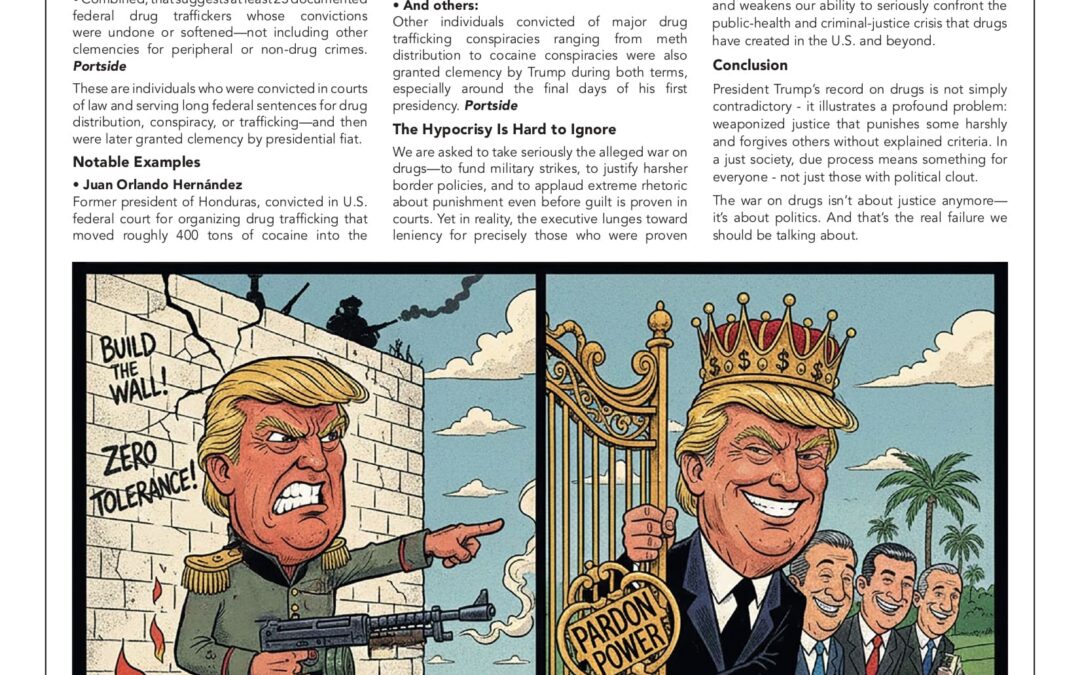
For years, Donald Trump thundered about a
tough war on drugs – even suggesting extreme
penalties for dealers and praising foreign leaders
who executed alleged traffickers without trial. Yet
the clemency record from his time in the White
House tells a very different story: one in which
convicted drug traffickers and kingpins have
been granted pardons or had their sentences
commuted after being properly adjudicated in
court. The result is a striking contradiction at the
heart of American criminal-justice policy.
How Many Drug Pardons and
Commutations?
According to analysis of recent clemency data
and reporting:
• Trump has pardoned or granted clemency to
at least 10 individuals convicted of serious drug-
related federal crimes in his second term alone.
The Washington Post
• During his first term, he also pardoned or
commuted the sentences of at least 13 other
convicted drug traffickers. Portside
• Combined, that suggests at least 23 documented
federal drug traffickers whose convictions
were undone or softened—not including other
clemencies for peripheral or non-drug crimes.
Portside
These are individuals who were convicted in courts
of law and serving long federal sentences for drug
distribution, conspiracy, or trafficking—and then
were later granted clemency by presidential fiat.
Notable Examples
• Juan Orlando Hernández
Former president of Honduras, convicted in U.S.
federal court for organizing drug trafficking that
moved roughly 400 tons of cocaine into the
United States. He was sentenced to 45 years in
prison then pardoned and released by Trump in
December 2025. Politico
• Ross Ulbricht
Founder of the Silk Road dark-web marketplace,
convicted of operating an online platform that
facilitated millions of dollars in illegal drug sales,
and serving life plus 40 years. Trump issued a full
pardon in January 2025. VPM
• Larry Hoover
Co-founder of the Chicago Gangster Disciples,
convicted of running a vast drug organization
and sentenced to multiple life terms. Trump
commuted his federal sentence in 2025, even as
a state murder conviction still stands. Justice.gov
• Garnett Gilbert Smith
Convicted of conspiracy to distribute cocaine
and serving a 25-year sentence, later granted
clemency. Wikipedia
• Anabel Valenzuela
Convicted of conspiracy to distribute significant
quantities of methamphetamine (50g+ with
forfeiture and laundering charges); sentence
commuted. Wikipedia
• And others:
Other individuals convicted of major drug
trafficking conspiracies ranging from meth
distribution to cocaine conspiracies were also
granted clemency by Trump during both terms,
especially around the final days of his first
presidency. Portside
The Hypocrisy Is Hard to Ignore
We are asked to take seriously the alleged war on
drugs—to fund military strikes, to justify harsher
border policies, and to applaud extreme rhetoric
about punishment even before guilt is proven in
courts. Yet in reality, the executive lunges toward
leniency for precisely those who were proven
guilty in courts of law.
The clemency power is constitutional. But when
wielded selectively—pardoning well-connected
traffickers and politically useful figures—it sends
a chilling message about fairness, equal justice,
and the rule of law. Critics note that some pardons
appear tied to political support, influence, or
lobbying rather than to any coherent view of
justice. The Washington Post.
The Real Costs
This double standard has real consequences.
While traffickers walk free or see decades-
long sentences erased, everyday communities
continue to suffer from addiction, violence, and
the unrelenting flow of fentanyl and other hard
drugs. Trump’s rhetoric often focused on killing
drug dealers abroad, even when due process was
absent or questionable. But his pardon list shines
a spotlight on a clemency policy that softens
punishment for those who already lost their day
in court.
Such inconsistent governance undermines trust
in both law enforcement and the justice system
and weakens our ability to seriously confront the
public-health and criminal-justice crisis that drugs
have created in the U.S. and beyond.
Conclusion
President Trump’s record on drugs is not simply
contradictory – it illustrates a profound problem:
weaponized justice that punishes some harshly
and forgives others without explained criteria. In
a just society, due process means something for
everyone – not just those with political clout.
The war on drugs isn’t about justice anymore—
it’s about politics. And that’s the real failure we
should be talking about.
PAID ADVERTISEMENT
SOURCES
Washington Post – Reporting on Trump’s second-term pardons and commutations for individuals convicted of serious federal drug offenses.
Portside – Documentation of clemencies granted during Trump’s first term, including drug-trafficking convictions undone or reduced.
Portside + additional clemency listings – Combined reporting establishing at least 23 federal drug-trafficking convictions affected by Trump clemency actions.
Politico – Coverage of the conviction, sentencing, and December 2025 presidential pardon of former Honduran president Juan Orlando Hernández (400-ton cocaine
trafficking conspiracy).
VPM (Virginia Public Media) – Reporting on Trump’s January 2025 full pardon of Ross Ulbricht, founder of Silk Road, convicted of facilitating large-scale online drug
trafficking.
Justice.gov – U.S. Department of Justice records regarding the federal conviction and later commutation of Gangster Disciples co-founder Larry Hoover.
Wikipedia (source summaries) – Entries documenting the convictions and clemencies of Garnett Gilbert Smith and Anabel Valenzuela (federal cocaine and
methamphetamine trafficking cases).
Portside (additional examples) – Reporting on additional high-level narcotics and conspiracy convictions receiving clemency during both Trump presidencies.
The above material is the exclusive work product and intellectual property of Brent Lambi and/or his assigns and/or licensees. Any republication, reproduction, distribution,
or use—whether in whole or in part—is strictly prohibited without express written permission. Select former works are available for purchase. Sponsorship and public
speaking engagements may also be arranged. Please contact Brent Lambi directly for further information.
by Brent Lambi | Dec 7, 2025 | Political
Donald Trump’s proclaimed “War
on Drugs” did not just fail — it in-
verted the basic logic of justice.
Consider Juan Orlando Hernán-
dez, former president of Honduras.
In 2024, a federal jury convicted
him of conspiring to import cocaine
into the United States after years of
investigation and testimony. Yet in-
stead of being treated as a caution-
ary tale, he has been portrayed by
some in Trump’s orbit as deserving
sympathy or reconsideration — a
striking contrast to how far less pow-
erful suspects are treated.
At the same time, investigative
journalists and human-rights or-
ganizations have raised questions
about certain U.S.-linked interdic-
tion operations abroad and at sea.
These reports do not prove unlaw-
ful conduct, but they describe inci-
dents where suspects died during
missions that produced no arrests,
trials, or publicly released evidence.
If even partly accurate, they suggest
the line between enforcement and
extrajudicial force has blurred.
The Constitution guarantees due
process and fair trial rights for all,
and it gives Congress — not the
president — authority to declare
war. International treaties ratified by
the United States further prohibit
the killing of individuals who are not
active combatants or who have not
been afforded judicial protections.
Yet while enforcement at the bot-
tom can be harsh and opaque, the
response at the top looks very dif-
ferent. Ross Ulbricht, convicted af-
ter a full trial and sentenced to life,
received a presidential pardon. His
guilt was established, but his sen-
tence was erased through executive
clemency.
A pattern emerges: unproven sus-
pects may face lethal force, accord-
ing to credible reporting, while prov-
en offenders may receive mercy.
Constitutional limits appear flexible
depending on political usefulness.
That is not equal justice. It is a hi-
erarchy shaped by influence.
When clemency repeatedly bene-
fits the well-connected, it raises a le-
gitimate public question: Is this truly
a war on drugs, or a system that pro-
tects the powerful while punishing
the powerless?
History will not remember this ap-
proach as strength. It will remember
it as a betrayal of the principle of
equal justice under law.
America has been told to “trust
the process” far too many times,
and too often that process leads to
sealed records, missing documents,
and silence from those in power.
With Congress passing the Epstein
Files Transparency Act, the question
now is simple: Will the public finally
see the truth — or another managed
illusion of it?
The law requires the Department
of Justice to release all unclassified
records related to Jeffrey Epstein’s
investigation and prosecution, in-
cluding materials involving associ-
ates, flight logs, internal DOJ com-
munications, and documentation of
his detention and death. It also re-
quires the documents to be posted
within 30 days in searchable, down-
loadable form.
Crucially, the DOJ cannot with-
hold information merely because it
might embarrass or politically dam-
age public officials.
Certain redactions are permit-
ted — such as victim identities,
child-sexual-abuse materials, and
content that could compromise
active investigations. But the law
provides no forensic audit ensuring
the records haven’t been altered or
erased before publication.
This moment is not about parti-
sanship. It is about whether a justice
system that failed victims for de-
cades can now be trusted to reveal
the full truth. America does not need
another promise of transparency. It
needs proof.
Justice Turned
Upside Down
The Hypocrisy of
Trump’s “War on Drugs”
America Doesn’t
Need Promises
It Needs the Truth
About the Epstein Files
SOURCES
DOJ & SDNY trial records: U.S. v. Juan Orlando Hernández (2024); Reuters & AP reporting
on prosecutors’ evidence. DOJ OIG (2017), ProPublica & Human Rights Watch investigations
on U.S.-linked interdiction practices. U.S. Constitution (Amend. V & VI; Art. I §8); Geneva
Conventions, ICCPR & U.N. Use-of-Force Principles. DOJ: Ross Ulbricht Sentencing (2015)
& White House Clemency List (2021). AP, NYT, Brookings & Harvard Law Review analyses of
Trump-era clemency patterns.
SOURCES
Epstein Files Transparency Act of 2024, Congressional text and summary, U.S. Congress.
(Requirements for release of “all unclassified records,” inclusion of materials involving
associates, flight logs, internal DOJ communications, detention documentation.)
Ibid. (Mandate that records be released within 30 days in searchable and downloadable
format.)
Ibid. (Prohibition on withholding or redacting records solely due to embarrassment,
reputational harm, or political damage.)
Ibid. (Allowed redactions: victim PII, child-sexual-abuse materials, items affecting active