The Shareholder Cost of Defending the Indefensible: Why What I Believe Was Serious Misconduct by a Federal Employee Can Damage a Trillion-Dollar Holding Company—and Why I, as Both Shareholder and Plaintiff, Am Asking Berkshire Hathaway to Choose Truth
We’re Both Getting Dirty
Honest
Politics
By Brent Lambi
OPINION |
Charlie Munger said it plain. “Never wrestle with a pig. You
both get dirty, and the pig likes it.” I want to say something
today that an opposing party in active litigation almost never
says. Berkshire Hathaway and I are both being hurt. By the
same thing. And it isn’t each other.
Case No. CI 26-1752, Douglas County District Court. I sued
Berkshire Hathaway HomeServices entities for breach of a
Buyer’s Listing Agreement and defamation. Separately, I have
a federal civil rights and FOIA enforcement case pending in
the U.S. District Court for the District of Nebraska, Case No.
8:26-cv-00101-SMB-RCC, against components of the DEA,
DOJ, and DHS.
–
want my state defamation case bogged down. Discovery in my
state case touches my federal case. If my state case never produces
discovery, their exposure shrinks. Delay protects them.
Resolution exposes them.
Now here is what most writers would never admit. Berkshire
is not the villain in this story. Berkshire is bleeding too.
Count the costs. Defense counsel fees, billed by the hour, in a
case the math says should have settled. Insurance reserves tied
up. Brand exposure every week the case stays in the news. Discomes
cheap. Every dollar Berkshire’s insurer spends defending
this case past the point where settlement made sense is a
dollar shareholders will not see. Charlie Munger could have
done that arithmetic on a napkin.
fronts at once. Filing fees, transcripts, expert costs, the unrecoverable
hours of my own life. Reputation hits in a small civic-
journalism market. Stress I will not pretend does not exist.
–
ing a return on this litigation is the federal actor who bene-
Which raises the only question that matters: why is this case
still being fought the way it is being fought?
I do not believe Berkshire Hathaway HomeServices, as a
–
tine state defamation and breach-of-contract case this way.
for delay, not resolution. Discovery resistance that costs more
than the underlying claim. A posture that drives up fees on
both sides while the actual exposure sits unchanged.
When the math does not work, somebody else is doing the
calculations.
I believe — and I will say it directly — that the defense stratinterests
outside the four corners of the Berkshire Hathaway
HomeServices contractual relationship. A third party. One
with its own reasons. One whose interests are not Berkshire’s
interests, and are certainly not mine.
If that is true, Berkshire is not the defendant. Berkshire is the
host. And I am the bait.
Charlie Munger warned about exactly this. When you wrestle
walks away clean while everyone else is covered in mud and
short on cash.
who keeps pushing for more depositions, more delay, more
motion practice in a case that should have closed months ago.
Whose money is paying for this? Whose strategy is this actually
serving?
And then look at the door. I am open to resolution. I have
always been open to resolution. A buyer’s agency dispute is
not a constitutional crisis. It is a contract and a duty of care,
–
sion-makers want to talk — not the defense apparatus, the
actual decision-makers — the door is open.
One actor laughing.
–
ers, and for every lawyer billing on this case, is whether anyone
is going to do the obvious thing: stop wrestling each other, and
look at who let the pig in.
–
las County District Court, and in the matter docketed as Case
No. 8:26-cv-00101-SMB-RCC, U.S. District Court for the District
author’s observation of the proceedings. Nothing herein is inare
presumed entitled to a full and fair adjudication on the
merits. Honest Politics welcomes responses for publication.
Archive
Reader Feedback
Podcasts
Much More
June 14, 2026
The Shareholder Cost of
Defending the Indefensible
Why What I Believe Was Serious Misconduct by a Federal Employee Can
Damage a Trillion-Dollar Holding Company—and Why I, as Both Shareholder
and Plaintiff, Am Asking Berkshire Hathaway to Choose Truth
OPINION | June 17, 2026
I am, simultaneously, two things in connection
with this matter. I am the plaintiff
in Case No. CI 26-1752, suing Berkshire Hathaway
HomeServices Ambassador Real
Estate, its parent chain, for the defamation
against me. I am also a Berkshire Hathaway
shareholder. I attended Berkshire’s annual
meeting in Omaha in May 2026. I hold stock
in the parent company my lawsuit names.
This dual standing is not a contradiction.
It is, in my opinion, the strongest argument
I can make to Berkshire’s senior leadership:
our interests are aligned, not opposed.
In a typical defamation case, the plaintiff
and the corporate defendant pull in opposite
directions. The plaintiff wants maximum
recovery; the company wants minimum
payout. Each side burns through
years of legal expense to discover where
the truth lies. Both sides emerge poorer, regardless
of verdict.
My case is different. I do not want maximum
recovery at Berkshire’s expense, because
Berkshire’s expense is partly my expense.
Once as a plaintiff awaiting relief, and
once again as a shareholder paying for the
defense. Every additional month of delay by
defense counsel costs me twice. It costs every
other Berkshire shareholder once.
In my opinion, what is happening is this:
a single bad actor inside a federal agency
– specifically, what I believe to have been
a materially incorrect April 29, 2025 DEA
FOIA response concerning my own records
– has set in motion a cascade of damage
that now flows through one of the largest
holding companies in the world. None
of this had to happen. It is happening because,
somewhere in the federal apparatus,
my name was mishandled, my record was
distorted, and the distorted record leaked
downstream into commercial compliance
pipelines that touch every brokerage, every
bank, every counterparty.
Honest
Politics
By Brent Lambi
THE COST CASCADE
Let me describe how the damage flows, as
a shareholder would see it.
Litigation defense cost. The hours billed to
this case by outside counsel do not come
from nowhere. They are paid by a subsidiary,
consolidated into HomeServices of
America’s results, and rolled up into Berkshire.
The defensive posture in this matter,
which in my opinion, is to file a motion to
dismiss, refuse to identify counsel, and decline
pre-trial resolution, is itself the most
expensive option available. Honest engagement
would be cheaper. Settlement would
be cheaper still. Each escalation transfers
shareholder capital to outside counsel.
Executive bandwidth. HomeServices’ senior
leadership must be briefed on material
litigation. BHI’s general counsel’s office
must be briefed on litigation that could
reach the parent. Every hour spent on a defamation
case rooted in bad federal data is
an hour not spent on capital allocation, on
succession planning, on the operating businesses
Warren Buffett and Greg Abel exist
to oversee.
“I am not asking Berkshire to
defend what its subsidiary did.
I am asking Berkshire to let
its subsidiary tell the truth.”
Reputational exposure. Berkshire’s brand
is its most valuable single asset. Mr. Buffett’s
own formulation: “Lose money for
the firm and I will be understanding. Lose
a shred of reputation for the firm and I will
be ruthless” applies whether or not BHI’s
senior leadership is aware of this case today.
Defamation litigation paired with what
I believe is obstruction creates the precise
reputational headwind Berkshire’s culture
is supposed to prevent.
Reserve and disclosure consequences.
Material litigation eventually consumes
balance-sheet capacity. Even where
reserves stay below disclosable thresholds,
they affect insurance pricing on errorsand-
omissions and directors-and-officers
coverage. Banks and counterparties notice
the litigation profile.
Recruitment and retention. Quality real
estate agents, the people who actually generate
revenue for BHHS Ambassador, are
increasingly selective about culture and
compliance. A brokerage publicly defending
against unresolved defamation allegations
is a recruiting headwind. The cost
shows up as lost agent placements, lost listings,
and lost revenue per office.
Strategic distortion. Most consequentially,
every dollar and hour spent defending the
indefensible distorts strategy. Resources
that should go into expansion, technology,
and agent training go instead to outside
counsel. The opportunity cost is invisible,
but it is the largest line item of all.
THE UPSTREAM CAUSE
Now run the chain backwards. None of
these costs exist without the original injury.
If the federal record of me as a citizen
had been accurate, no compliance vendor
would have flagged me, no brokerage compliance
officer would have escalated, no
listing agent would have been primed to
believe what they were told. The contract
would have been honored. The alleged defamation
would not have occurred. There
would be no lawsuit. There would be no
defense costs, no executive distraction, no
reputational drag, no opportunity cost.
One bad federal employee and the costs
cascade through a trillion-dollar holding
company.
THE ASK
This is why, in my opinion, the argument
that honest testimony would clear my
name is not only personally important to
me. It is important from a fiduciary standpoint
to Berkshire Hathaway. The senior
leadership at BHI owes its shareholders,
including this one, a duty to take the cheapest,
fastest, most honest path through this
matter. That path runs through truthful
testimony. It does not run through continued
litigation tactics.
I am not asking Berkshire to defend what
its subsidiary did. I am asking Berkshire to
let its subsidiary tell the truth.
The Shareholder Cost of Defending the Indefensible: Why What I Believe Was Serious Misconduct by a Federal Employee Can Damage a Trillion-Dollar Holding Company—and Why I, as Both Shareholder and Plaintiff, Am Asking Berkshire Hathaway to Choose Truth
We’re Both Getting Dirty
Honest
Politics
By Brent Lambi
OPINION |
Charlie Munger said it plain. “Never wrestle with a pig. You
both get dirty, and the pig likes it.” I want to say something
today that an opposing party in active litigation almost never
says. Berkshire Hathaway and I are both being hurt. By the
same thing. And it isn’t each other.
Case No. CI 26-1752, Douglas County District Court. I sued
Berkshire Hathaway HomeServices entities for breach of a
Buyer’s Listing Agreement and defamation. Separately, I have
a federal civil rights and FOIA enforcement case pending in
the U.S. District Court for the District of Nebraska, Case No.
8:26-cv-00101-SMB-RCC, against components of the DEA,
DOJ, and DHS.
–
want my state defamation case bogged down. Discovery in my
state case touches my federal case. If my state case never produces
discovery, their exposure shrinks. Delay protects them.
Resolution exposes them.
Now here is what most writers would never admit. Berkshire
is not the villain in this story. Berkshire is bleeding too.
Count the costs. Defense counsel fees, billed by the hour, in a
case the math says should have settled. Insurance reserves tied
up. Brand exposure every week the case stays in the news. Discomes
cheap. Every dollar Berkshire’s insurer spends defending
this case past the point where settlement made sense is a
dollar shareholders will not see. Charlie Munger could have
done that arithmetic on a napkin.
fronts at once. Filing fees, transcripts, expert costs, the unrecoverable
hours of my own life. Reputation hits in a small civic-
journalism market. Stress I will not pretend does not exist.
–
ing a return on this litigation is the federal actor who bene-
Which raises the only question that matters: why is this case
still being fought the way it is being fought?
I do not believe Berkshire Hathaway HomeServices, as a
–
tine state defamation and breach-of-contract case this way.
for delay, not resolution. Discovery resistance that costs more
than the underlying claim. A posture that drives up fees on
both sides while the actual exposure sits unchanged.
When the math does not work, somebody else is doing the
calculations.
I believe — and I will say it directly — that the defense stratinterests
outside the four corners of the Berkshire Hathaway
HomeServices contractual relationship. A third party. One
with its own reasons. One whose interests are not Berkshire’s
interests, and are certainly not mine.
If that is true, Berkshire is not the defendant. Berkshire is the
host. And I am the bait.
Charlie Munger warned about exactly this. When you wrestle
walks away clean while everyone else is covered in mud and
short on cash.
who keeps pushing for more depositions, more delay, more
motion practice in a case that should have closed months ago.
Whose money is paying for this? Whose strategy is this actually
serving?
And then look at the door. I am open to resolution. I have
always been open to resolution. A buyer’s agency dispute is
not a constitutional crisis. It is a contract and a duty of care,
–
sion-makers want to talk — not the defense apparatus, the
actual decision-makers — the door is open.
One actor laughing.
–
ers, and for every lawyer billing on this case, is whether anyone
is going to do the obvious thing: stop wrestling each other, and
look at who let the pig in.
–
las County District Court, and in the matter docketed as Case
No. 8:26-cv-00101-SMB-RCC, U.S. District Court for the District
author’s observation of the proceedings. Nothing herein is inare
presumed entitled to a full and fair adjudication on the
merits. Honest Politics welcomes responses for publication.
Archive
Reader Feedback
Podcasts
Much More
June 14, 2026
The Shareholder Cost of
Defending the Indefensible
Why What I Believe Was Serious Misconduct by a Federal Employee Can
Damage a Trillion-Dollar Holding Company—and Why I, as Both Shareholder
and Plaintiff, Am Asking Berkshire Hathaway to Choose Truth
OPINION | June 17, 2026
I am, simultaneously, two things in connection
with this matter. I am the plaintiff
in Case No. CI 26-1752, suing Berkshire Hathaway
HomeServices Ambassador Real
Estate, its parent chain, for the defamation
against me. I am also a Berkshire Hathaway
shareholder. I attended Berkshire’s annual
meeting in Omaha in May 2026. I hold stock
in the parent company my lawsuit names.
This dual standing is not a contradiction.
It is, in my opinion, the strongest argument
I can make to Berkshire’s senior leadership:
our interests are aligned, not opposed.
In a typical defamation case, the plaintiff
and the corporate defendant pull in opposite
directions. The plaintiff wants maximum
recovery; the company wants minimum
payout. Each side burns through
years of legal expense to discover where
the truth lies. Both sides emerge poorer, regardless
of verdict.
My case is different. I do not want maximum
recovery at Berkshire’s expense, because
Berkshire’s expense is partly my expense.
Once as a plaintiff awaiting relief, and
once again as a shareholder paying for the
defense. Every additional month of delay by
defense counsel costs me twice. It costs every
other Berkshire shareholder once.
In my opinion, what is happening is this:
a single bad actor inside a federal agency
– specifically, what I believe to have been
a materially incorrect April 29, 2025 DEA
FOIA response concerning my own records
– has set in motion a cascade of damage
that now flows through one of the largest
holding companies in the world. None
of this had to happen. It is happening because,
somewhere in the federal apparatus,
my name was mishandled, my record was
distorted, and the distorted record leaked
downstream into commercial compliance
pipelines that touch every brokerage, every
bank, every counterparty.
Honest
Politics
By Brent Lambi
THE COST CASCADE
Let me describe how the damage flows, as
a shareholder would see it.
Litigation defense cost. The hours billed to
this case by outside counsel do not come
from nowhere. They are paid by a subsidiary,
consolidated into HomeServices of
America’s results, and rolled up into Berkshire.
The defensive posture in this matter,
which in my opinion, is to file a motion to
dismiss, refuse to identify counsel, and decline
pre-trial resolution, is itself the most
expensive option available. Honest engagement
would be cheaper. Settlement would
be cheaper still. Each escalation transfers
shareholder capital to outside counsel.
Executive bandwidth. HomeServices’ senior
leadership must be briefed on material
litigation. BHI’s general counsel’s office
must be briefed on litigation that could
reach the parent. Every hour spent on a defamation
case rooted in bad federal data is
an hour not spent on capital allocation, on
succession planning, on the operating businesses
Warren Buffett and Greg Abel exist
to oversee.
“I am not asking Berkshire to
defend what its subsidiary did.
I am asking Berkshire to let
its subsidiary tell the truth.”
Reputational exposure. Berkshire’s brand
is its most valuable single asset. Mr. Buffett’s
own formulation: “Lose money for
the firm and I will be understanding. Lose
a shred of reputation for the firm and I will
be ruthless” applies whether or not BHI’s
senior leadership is aware of this case today.
Defamation litigation paired with what
I believe is obstruction creates the precise
reputational headwind Berkshire’s culture
is supposed to prevent.
Reserve and disclosure consequences.
Material litigation eventually consumes
balance-sheet capacity. Even where
reserves stay below disclosable thresholds,
they affect insurance pricing on errorsand-
omissions and directors-and-officers
coverage. Banks and counterparties notice
the litigation profile.
Recruitment and retention. Quality real
estate agents, the people who actually generate
revenue for BHHS Ambassador, are
increasingly selective about culture and
compliance. A brokerage publicly defending
against unresolved defamation allegations
is a recruiting headwind. The cost
shows up as lost agent placements, lost listings,
and lost revenue per office.
Strategic distortion. Most consequentially,
every dollar and hour spent defending the
indefensible distorts strategy. Resources
that should go into expansion, technology,
and agent training go instead to outside
counsel. The opportunity cost is invisible,
but it is the largest line item of all.
THE UPSTREAM CAUSE
Now run the chain backwards. None of
these costs exist without the original injury.
If the federal record of me as a citizen
had been accurate, no compliance vendor
would have flagged me, no brokerage compliance
officer would have escalated, no
listing agent would have been primed to
believe what they were told. The contract
would have been honored. The alleged defamation
would not have occurred. There
would be no lawsuit. There would be no
defense costs, no executive distraction, no
reputational drag, no opportunity cost.
One bad federal employee and the costs
cascade through a trillion-dollar holding
company.
THE ASK
This is why, in my opinion, the argument
that honest testimony would clear my
name is not only personally important to
me. It is important from a fiduciary standpoint
to Berkshire Hathaway. The senior
leadership at BHI owes its shareholders,
including this one, a duty to take the cheapest,
fastest, most honest path through this
matter. That path runs through truthful
testimony. It does not run through continued
litigation tactics.
I am not asking Berkshire to defend what
its subsidiary did. I am asking Berkshire to
let its subsidiary tell the truth.
The Shareholder Cost of Defending the Indefensible: Why What I Believe Was Serious Misconduct by a Federal Employee Can Damage a Trillion-Dollar Holding Company—and Why I, as Both Shareholder and Plaintiff, Am Asking Berkshire Hathaway to Choose Truth
We’re Both Getting Dirty
Honest
Politics
By Brent Lambi
OPINION |
Charlie Munger said it plain. “Never wrestle with a pig. You
both get dirty, and the pig likes it.” I want to say something
today that an opposing party in active litigation almost never
says. Berkshire Hathaway and I are both being hurt. By the
same thing. And it isn’t each other.
Case No. CI 26-1752, Douglas County District Court. I sued
Berkshire Hathaway HomeServices entities for breach of a
Buyer’s Listing Agreement and defamation. Separately, I have
a federal civil rights and FOIA enforcement case pending in
the U.S. District Court for the District of Nebraska, Case No.
8:26-cv-00101-SMB-RCC, against components of the DEA,
DOJ, and DHS.
–
want my state defamation case bogged down. Discovery in my
state case touches my federal case. If my state case never produces
discovery, their exposure shrinks. Delay protects them.
Resolution exposes them.
Now here is what most writers would never admit. Berkshire
is not the villain in this story. Berkshire is bleeding too.
Count the costs. Defense counsel fees, billed by the hour, in a
case the math says should have settled. Insurance reserves tied
up. Brand exposure every week the case stays in the news. Discomes
cheap. Every dollar Berkshire’s insurer spends defending
this case past the point where settlement made sense is a
dollar shareholders will not see. Charlie Munger could have
done that arithmetic on a napkin.
fronts at once. Filing fees, transcripts, expert costs, the unrecoverable
hours of my own life. Reputation hits in a small civic-
journalism market. Stress I will not pretend does not exist.
–
ing a return on this litigation is the federal actor who bene-
Which raises the only question that matters: why is this case
still being fought the way it is being fought?
I do not believe Berkshire Hathaway HomeServices, as a
–
tine state defamation and breach-of-contract case this way.
for delay, not resolution. Discovery resistance that costs more
than the underlying claim. A posture that drives up fees on
both sides while the actual exposure sits unchanged.
When the math does not work, somebody else is doing the
calculations.
I believe — and I will say it directly — that the defense stratinterests
outside the four corners of the Berkshire Hathaway
HomeServices contractual relationship. A third party. One
with its own reasons. One whose interests are not Berkshire’s
interests, and are certainly not mine.
If that is true, Berkshire is not the defendant. Berkshire is the
host. And I am the bait.
Charlie Munger warned about exactly this. When you wrestle
walks away clean while everyone else is covered in mud and
short on cash.
who keeps pushing for more depositions, more delay, more
motion practice in a case that should have closed months ago.
Whose money is paying for this? Whose strategy is this actually
serving?
And then look at the door. I am open to resolution. I have
always been open to resolution. A buyer’s agency dispute is
not a constitutional crisis. It is a contract and a duty of care,
–
sion-makers want to talk — not the defense apparatus, the
actual decision-makers — the door is open.
One actor laughing.
–
ers, and for every lawyer billing on this case, is whether anyone
is going to do the obvious thing: stop wrestling each other, and
look at who let the pig in.
–
las County District Court, and in the matter docketed as Case
No. 8:26-cv-00101-SMB-RCC, U.S. District Court for the District
author’s observation of the proceedings. Nothing herein is inare
presumed entitled to a full and fair adjudication on the
merits. Honest Politics welcomes responses for publication.
Archive
Reader Feedback
Podcasts
Much More
June 14, 2026
The Shareholder Cost of
Defending the Indefensible
Why What I Believe Was Serious Misconduct by a Federal Employee Can
Damage a Trillion-Dollar Holding Company—and Why I, as Both Shareholder
and Plaintiff, Am Asking Berkshire Hathaway to Choose Truth
OPINION | June 17, 2026
I am, simultaneously, two things in connection
with this matter. I am the plaintiff
in Case No. CI 26-1752, suing Berkshire Hathaway
HomeServices Ambassador Real
Estate, its parent chain, for the defamation
against me. I am also a Berkshire Hathaway
shareholder. I attended Berkshire’s annual
meeting in Omaha in May 2026. I hold stock
in the parent company my lawsuit names.
This dual standing is not a contradiction.
It is, in my opinion, the strongest argument
I can make to Berkshire’s senior leadership:
our interests are aligned, not opposed.
In a typical defamation case, the plaintiff
and the corporate defendant pull in opposite
directions. The plaintiff wants maximum
recovery; the company wants minimum
payout. Each side burns through
years of legal expense to discover where
the truth lies. Both sides emerge poorer, regardless
of verdict.
My case is different. I do not want maximum
recovery at Berkshire’s expense, because
Berkshire’s expense is partly my expense.
Once as a plaintiff awaiting relief, and
once again as a shareholder paying for the
defense. Every additional month of delay by
defense counsel costs me twice. It costs every
other Berkshire shareholder once.
In my opinion, what is happening is this:
a single bad actor inside a federal agency
– specifically, what I believe to have been
a materially incorrect April 29, 2025 DEA
FOIA response concerning my own records
– has set in motion a cascade of damage
that now flows through one of the largest
holding companies in the world. None
of this had to happen. It is happening because,
somewhere in the federal apparatus,
my name was mishandled, my record was
distorted, and the distorted record leaked
downstream into commercial compliance
pipelines that touch every brokerage, every
bank, every counterparty.
Honest
Politics
By Brent Lambi
THE COST CASCADE
Let me describe how the damage flows, as
a shareholder would see it.
Litigation defense cost. The hours billed to
this case by outside counsel do not come
from nowhere. They are paid by a subsidiary,
consolidated into HomeServices of
America’s results, and rolled up into Berkshire.
The defensive posture in this matter,
which in my opinion, is to file a motion to
dismiss, refuse to identify counsel, and decline
pre-trial resolution, is itself the most
expensive option available. Honest engagement
would be cheaper. Settlement would
be cheaper still. Each escalation transfers
shareholder capital to outside counsel.
Executive bandwidth. HomeServices’ senior
leadership must be briefed on material
litigation. BHI’s general counsel’s office
must be briefed on litigation that could
reach the parent. Every hour spent on a defamation
case rooted in bad federal data is
an hour not spent on capital allocation, on
succession planning, on the operating businesses
Warren Buffett and Greg Abel exist
to oversee.
“I am not asking Berkshire to
defend what its subsidiary did.
I am asking Berkshire to let
its subsidiary tell the truth.”
Reputational exposure. Berkshire’s brand
is its most valuable single asset. Mr. Buffett’s
own formulation: “Lose money for
the firm and I will be understanding. Lose
a shred of reputation for the firm and I will
be ruthless” applies whether or not BHI’s
senior leadership is aware of this case today.
Defamation litigation paired with what
I believe is obstruction creates the precise
reputational headwind Berkshire’s culture
is supposed to prevent.
Reserve and disclosure consequences.
Material litigation eventually consumes
balance-sheet capacity. Even where
reserves stay below disclosable thresholds,
they affect insurance pricing on errorsand-
omissions and directors-and-officers
coverage. Banks and counterparties notice
the litigation profile.
Recruitment and retention. Quality real
estate agents, the people who actually generate
revenue for BHHS Ambassador, are
increasingly selective about culture and
compliance. A brokerage publicly defending
against unresolved defamation allegations
is a recruiting headwind. The cost
shows up as lost agent placements, lost listings,
and lost revenue per office.
Strategic distortion. Most consequentially,
every dollar and hour spent defending the
indefensible distorts strategy. Resources
that should go into expansion, technology,
and agent training go instead to outside
counsel. The opportunity cost is invisible,
but it is the largest line item of all.
THE UPSTREAM CAUSE
Now run the chain backwards. None of
these costs exist without the original injury.
If the federal record of me as a citizen
had been accurate, no compliance vendor
would have flagged me, no brokerage compliance
officer would have escalated, no
listing agent would have been primed to
believe what they were told. The contract
would have been honored. The alleged defamation
would not have occurred. There
would be no lawsuit. There would be no
defense costs, no executive distraction, no
reputational drag, no opportunity cost.
One bad federal employee and the costs
cascade through a trillion-dollar holding
company.
THE ASK
This is why, in my opinion, the argument
that honest testimony would clear my
name is not only personally important to
me. It is important from a fiduciary standpoint
to Berkshire Hathaway. The senior
leadership at BHI owes its shareholders,
including this one, a duty to take the cheapest,
fastest, most honest path through this
matter. That path runs through truthful
testimony. It does not run through continued
litigation tactics.
I am not asking Berkshire to defend what
its subsidiary did. I am asking Berkshire to
let its subsidiary tell the truth.
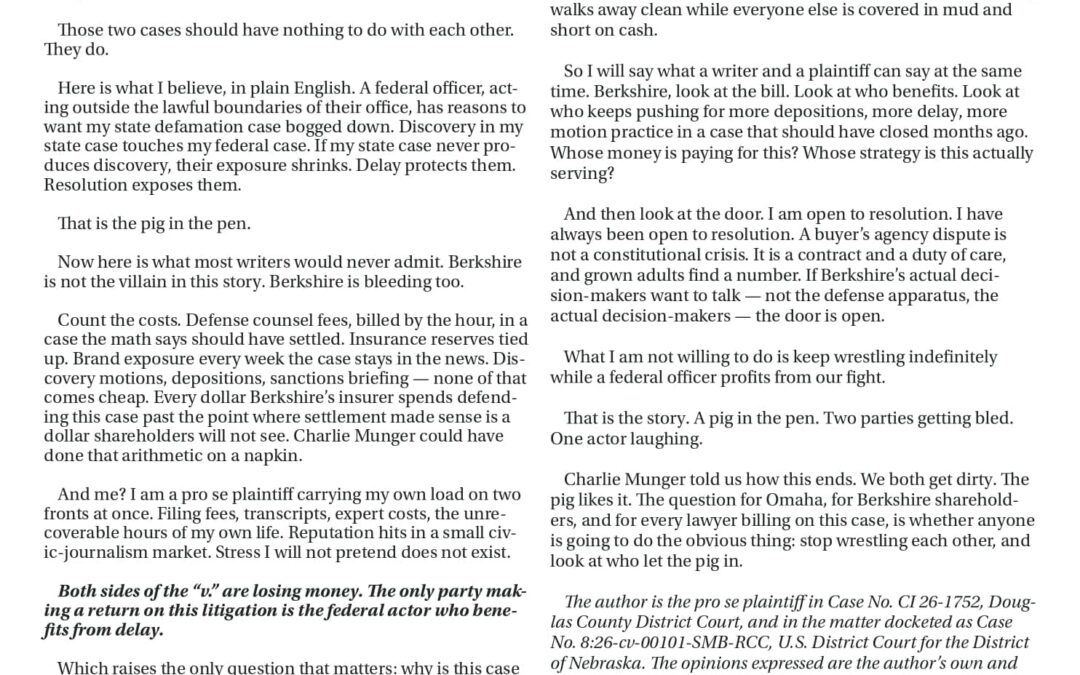
We’re Both Getting Dirty: Berkshire Hathaway HomeServices and I are both being financially bled by the same thing – and it isn’t each other. The pig in Charlie Munger’s parable is wearing a federal badge.

If Terrorists Killed 68,000 Americans a Year
Imagine a foreign enemy that slipped across our borders and killed sixty-eight thousand Americans a year. That is more than twenty times the toll of September 11th, every year, without end. We would summon every dollar and every agency and not rest until the threat was destroyed. That number is not imaginary. It is the estimated annual death toll of Americans who go without adequate health care and against that enemy we have declared no war at all. 1
Judge a society not by how it treats the strong but by how it cares for those at the beginning and the end of life. By that measure, America is failing. We can fund a war on the far side of the planet within a news cycle, yet we tell a young mother there is no money for the daycare she needs to work, and her grandmother no affordable place to grow old. Childcare now averages more than $13,000 a year, approaching $28,000 for an infant in the costliest markets. 2 That is unaffordable, by the government’s own seven-percent standard, in every single state. 3 Small wonder that seven in ten Americans now say children have simply become too expensive to raise. 4
The far end of life is no kinder. Assisted living runs about $74,000 a year and a nursing home room north of $110,000. That is enough to liquidate a lifetime of savings in two or three years and leave the children to shoulder the rest. 5 Medicare spares most seniors the terror of being uninsured, but it stops at the nursing home door; it does not pay for long-term care, leaving Medicaid, now targeted for deep cuts as the only backstop.
Between the cradle and the grave lies the cruelest gap of all. More than twenty-six million Americans carry no insurance, most because they cannot afford it. 6 The cost is counted in lives. Roughly 20,000 American children die each year who would have lived had this country merely matched the survival rates of its peer nations. 7 This is a gap driven by infant mortality, accidents, and violence that prevention and access are built to catch. Independent modeling projects that the proposed Medicaid reductions alone would cause more than 51,000 additional preventable deaths a year, falling hardest on the elderly and disabled who depend on it. 8 For the man who skips the appointment because the bill frightens him more than the symptom, limited health care is simply death at an earlier date.
So imagine it again. Sixty-eight thousand of our own, dead every year, while we move heaven and earth to stop a fraction of that number when the killer carries a foreign flag. America does not lack the resources to fight for Americans. It lacks the will to count its own dead as worth the trouble. Until we are willing to spend on the cradle and the grave what we so freely spend on the battlefield, the deadliest threat to American lives will remain the one we refuse to name: ourselves.
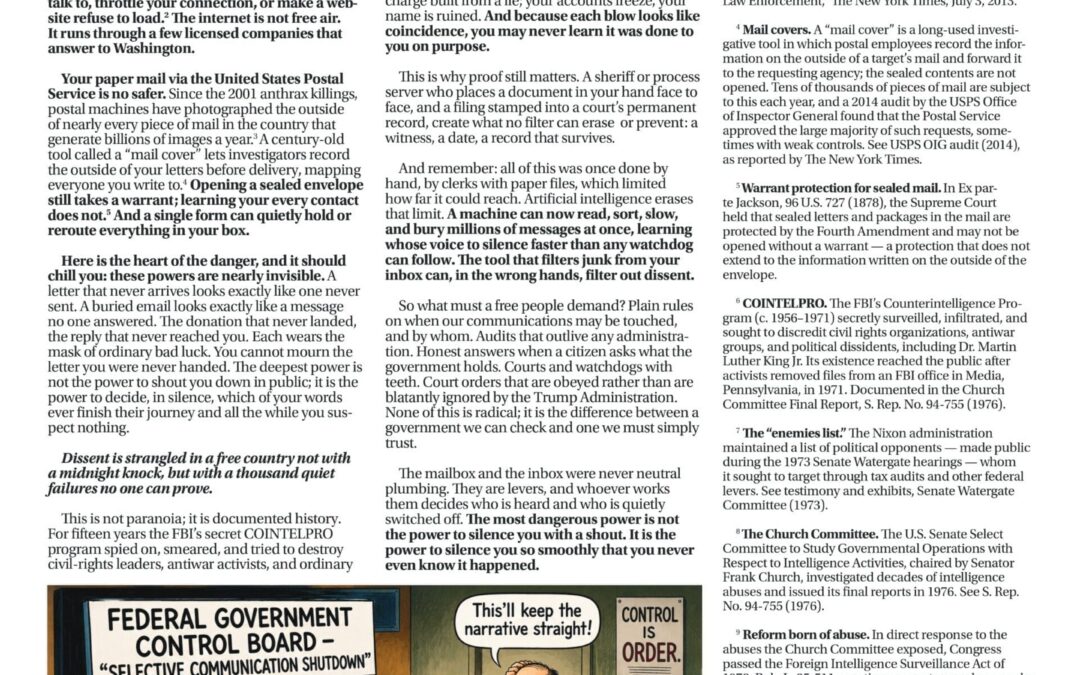
Who Gets to Decide If You’re Heard? Actually, the Federal Government.
Who Gets to Decide If You’re Heard?
Actually, the Federal Government
Honest
Politics
By Brent Lambi
The mailbox and the inbox were never neutral plumbing. They are levers and
the most dangerous kind of silence is the kind you never even notice.
OPINION | June 3, 2026
We live by two quiet beliefs: that the letter we mail will arrive, and the email we send will land completely unfiltered without interference. We stake our friendships, our businesses, even our court cases on them. Yet both pass through hands we never see, and those hands hold more power than we dare imagine or realize.
Email is NOT a sealed letter passed hand to hand. It is an electronic postcard relayed through sorting machines. First your provider, then theirs, and strangers in between. At each stop software decides whether your words move on, get buried, or vanish. You meet this power daily in the spam folder: a filter you never set, choosing what you will never see. Now add the government’s reach. A 1994 law requires phone carriers to build their networks so the state can intercept communications on lawful order; regulators stretched that mandate to broadband internet in 2005.1 Providers can be forced to surrender your messages, log who you talk to, throttle your connection, or make a website refuse to load.2 The internet is not free air. It runs through a few licensed companies that answer to Washington.
Your paper mail via the United States Postal Service is no safer. Since the 2001 anthrax killings, postal machines have photographed the outside of nearly every piece of mail in the country that generate billions of images a year.3 A century-old tool called a “mail cover” lets investigators record the outside of your letters before delivery, mapping everyone you write to.4 Opening a sealed envelope still takes a warrant; learning your every contact does not.5 And a single form can quietly hold or reroute everything in your box.
Here is the heart of the danger, and it should chill you: these powers are nearly invisible. A letter that never arrives looks exactly like one never sent. A buried email looks exactly like a message no one answered. The donation that never landed, the reply that never reached you. Each wears the mask of ordinary bad luck. You cannot mourn the letter you were never handed. The deepest power is not the power to shout you down in public; it is the power to decide, in silence, which of your words ever finish their journey and all the while you suspect nothing.
Dissent is strangled in a free country not with a midnight knock, but with a thousand quiet failures no one can prove.
This is not paranoia; it is documented history. For fifteen years the FBI’s secret COINTELPRO program spied on, smeared, and tried to destroy civil-rights leaders, antiwar activists, and ordinary dissenters.6 A president kept an “enemies list” and turned federal agencies loose on the names.7 None of it was confessed. It took a break-in and the Church Committee hearings to expose it,8 and the warrant rules we rely on today exist only because these powers were already abused once.9
And it is not only history. Beginning in 2025, the government invoked a 1798 wartime law to deport people it branded members of a foreign “terrorist” group with sharply limited opportunities for hearings and judicial review. 10 When a judge ordered the flights stopped, the planes landed in a foreign prison anyway, and the court found probable cause for criminal contempt. 11 The Supreme Court later ruled the people swept up had been denied due process, given barely a day to show the government had the wrong man. 12 The official Trump defense: that judges had no right to second-guess a “national security” call.
Sit with that, for it is the whole nightmare in a single line. Once Trump officials brand you a “threat,” they claim the right to act first and answer to a court later, if ever. Now picture that machinery aimed at a critic, a donor, a journalist, or a political rival by a government willing to ignore the courts and warrant requirements and invent the label. Your funding withers as contributions silently fail to arrive. Your website slows to nothing. Your mail disappears. An investigation opens on a charge built from a lie; your accounts freeze, your name is ruined. And because each blow looks like coincidence, you may never learn it was done to you on purpose.
This is why proof still matters. A sheriff or process server who places a document in your hand face to face, and a filing stamped into a court’s permanent record, create what no filter can erase or prevent: a witness, a date, a record that survives.
And remember: all of this was once done by hand, by clerks with paper files, which limited how far it could reach. Artificial intelligence erases that limit. A machine can now read, sort, slow, and bury millions of messages at once, learning whose voice to silence faster than any watchdog can follow. The tool that filters junk from your inbox can, in the wrong hands, filter out dissent.
So what must a free people demand? Plain rules on when our communications may be touched, and by whom. Audits that outlive any administration. Honest answers when a citizen asks what the government holds. Courts and watchdogs with teeth. Court orders that are obeyed rather than are blatantly ignored by the Trump Administration. None of this is radical; it is the difference between a government we can check and one we must simply trust.
The mailbox and the inbox were never neutral plumbing. They are levers, and whoever works them decides who is heard and who is quietly switched off. The most dangerous power is not the power to silence you with a shout. It is the power to silence you so smoothly that you never even know it happened.
NOTES & SOURCES
1 Lawful-intercept mandate. The Communications Assistance for Law Enforcement Act (CALEA), Pub. L. 103-414, enacted in 1994, requires telecommunications carriers to design their networks so that, with a court order or other lawful authorization, the government can intercept communications and obtain call-identifying information. Originally it covered telephone and similar services; in 2005 the Federal Communications Commission extended its reach to facilities-based broadband internet access and interconnected internet phone service. See 47 U.S.C. §§ 1001–1010; FCC, fcc.gov/calea.
2 Compelled disclosure and network control. Under the Electronic Communications Privacy Act and its Stored Communications Act (1986), providers can be compelled by warrant, court order, or subpoena to turn over the contents of communications and records of whom a customer contacts. Because internet access is delivered by regulated private carriers, the same systems that manage network traffic can be used to slow, prioritize, or block particular destinations.
See 18 U.S.C. §§ 2701–2712.
3 Mail imaging. Through the Mail Isolation Control and Tracking program, Postal Service equipment photographs the exterior of essentially every piece of mail processed in the United States — roughly 160 billion items in the year before the program became public. Created after the 2001 anthrax killings, it surfaced in 2013 when the FBI cited it in a ricin-letter investigation. See Ron Nixon, “U.S. Postal Service Logging All Mail for Law Enforcement,” The New York Times, July 3, 2013.
4 Mail covers. A “mail cover” is a long-used investigative tool in which postal employees record the information on the outside of a target’s mail and forward it to the requesting agency; the sealed contents are not opened. Tens of thousands of pieces of mail are subject to this each year, and a 2014 audit by the USPS Office of Inspector General found that the Postal Service approved the large majority of such requests, sometimes with weak controls. See USPS OIG audit (2014), as reported by The New York Times.
5 Warrant protection for sealed mail. In Ex parte Jackson, 96 U.S. 727 (1878), the Supreme Court held that sealed letters and packages in the mail are protected by the Fourth Amendment and may not be opened without a warrant — a protection that does not extend to the information written on the outside of the envelope.
6 COINTELPRO. The FBI’s Counterintelligence Program (c. 1956–1971) secretly surveilled, infiltrated, and sought to discredit civil rights organizations, antiwar groups, and political dissidents, including Dr. Martin Luther King Jr. Its existence reached the public after activists removed files from an FBI office in Media, Pennsylvania, in 1971. Documented in the Church Committee Final Report, S. Rep. No. 94-755 (1976).
7 The “enemies list.” The Nixon administration maintained a list of political opponents — made public during the 1973 Senate Watergate hearings — whom it sought to target through tax audits and other federal levers. See testimony and exhibits, Senate Watergate Committee (1973).
8 The Church Committee. The U.S. Senate Select Committee to Study Governmental Operations with Respect to Intelligence Activities, chaired by Senator Frank Church, investigated decades of intelligence abuses and issued its final reports in 1976. See S. Rep. No. 94-755 (1976).
9 Reform born of abuse. In direct response to the abuses the Church Committee exposed, Congress passed the Foreign Intelligence Surveillance Act of 1978, Pub. L. 95-511, creating warrant procedures and a specialized court for national-security surveillance. See 50 U.S.C. § 1801 et seq.
10 Wartime law, no hearings. Beginning in March 2025, the Trump administration invoked the Alien Enemies Act of 1798 — a wartime statute previously used for World War II–era internment — to rapidly deport Venezuelan nationals it accused of belonging to Tren de Aragua, which it had designated a foreign terrorist organization. Its legal position was that it could carry out these removals without the hearings or judicial review ordinarily required; in court filings the government conceded that many of those removed had no U.S. criminal records. See NPR, “Trump asks Supreme Court to allow deportations under Alien Enemies Act,” March 28, 2025.
11 Contempt. After Chief Judge James Boasberg of the U.S. District Court for the District of Columbia issued a temporary restraining order halting the deportation flights, the planes nonetheless arrived in El Salvador. On April 16, 2025, the judge found probable cause to hold the government in criminal contempt for violating the order; the Justice Department argued he had overstepped into matters of foreign policy. See NPR, April 16, 2025.
12 Due process denied. In a per curiam decision on May 16, 2025 (7–2), the U.S. Supreme Court found that roughly 24 hours’ notice before removal, lacking information on how to exercise due-process rights, did not pass constitutional muster, and barred further removals of the named plaintiffs pending review. A federal judge separately ruled in December 2025 that the men deported in March had been denied due process. See Courthouse News Service, May 16, 2025; NPR, Dec. 22, 2025.
Scan the code to visit
HONEST-POLITICS.COM